Thu, September 17, 2026

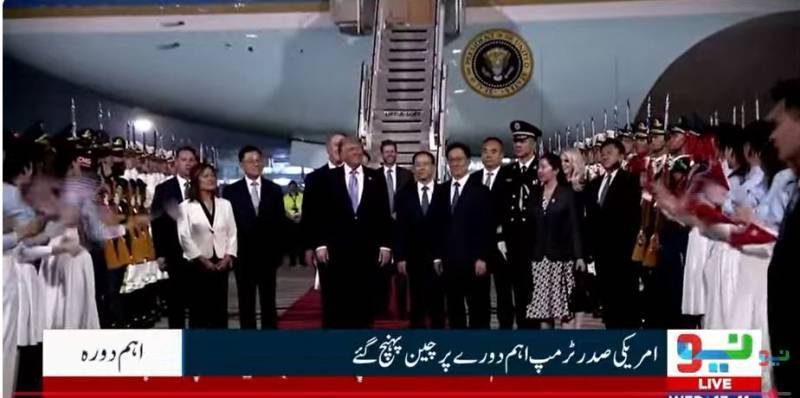
Beijing (Web Desk/Agencies): President Donald Trump arrived in Beijing on Wednesday alongside a notable group of business leaders that included Nvidia CEO Jensen Huang and tech billionaire Elon Musk.
The visit comes as he pledged to press Chinese President Xi Jinping to “open up” China to American companies during a two-day summit.
The trip marks the first time in nearly a decade that a US president has visited China. Trump is seeking to secure potential economic agreements, preserve a fragile trade understanding between the two major economies, and strengthen his domestic political standing, which has been affected by tensions connected to the war with Iran.
The accompanying executives are largely from companies trying to resolve regulatory and commercial issues in China, including Nvidia, which has struggled to obtain approval to sell its advanced H200 artificial intelligence chips in the Chinese market.
A source familiar with the matter said Trump unexpectedly invited Huang to join the delegation at the last moment, and he was later seen boarding Air Force One during a refuelling stop in Alaska on the way to Beijing.
On his Truth Social account, Trump stated, “I will be asking President Xi, a Leader of extraordinary distinction, to 'open up' China so that these brilliant people can work their magic,” adding that this would be his initial demand in the discussions.
In response, Chinese foreign ministry spokesperson Guo Jiakun said Beijing is willing to “expand cooperation, manage differences and inject more stability and certainty into the turbulent world”.
At the same time, US trade representative Scott Bessent concluded three hours of preliminary negotiations with Chinese officials in South Korea. Chinese state media outlet Xinhua characterized the talks as “candid, in-depth and constructive”, though no further specifics were released.
During the visit, Trump is expected to be welcomed with formal ceremonies at the Great Hall of the People, followed by a tour of the Temple of Heaven, a UNESCO heritage site, and a state banquet in his honor.
Alongside trade discussions, the agenda is also expected to include sensitive topics such as the ongoing Iran conflict and US arms sales to Taiwan, an issue that remains a major point of contention for Beijing, particularly regarding a proposed $14 billion weapons package still awaiting approval.
Both sides are working to uphold a trade truce agreed last October, under which the US suspended steep tariffs on Chinese goods while China eased its stance on restricting exports of rare earth materials essential for industries such as electric vehicles and defense manufacturing.
The discussions are also expected to explore mechanisms for expanding bilateral trade and investment, as well as dialogue on artificial intelligence cooperation, while Washington aims to boost exports of Boeing aircraft, agricultural products, and energy resources to reduce its long-standing trade deficit.
Despite these efforts, Trump enters the negotiations facing a relatively constrained position. US courts have limited his ability to impose tariffs freely on imports from China and other countries, while domestic economic pressures linked to the Iran war have contributed to inflation concerns and added political strain ahead of upcoming midterm elections.
Analysts note that although China is also facing economic challenges, Xi Jinping operates under comparatively less immediate pressure, giving Beijing a stronger negotiating stance.
Neo News | Copyright © 2026