Thu, September 17, 2026

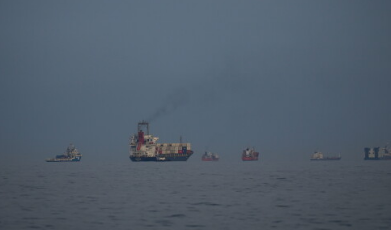
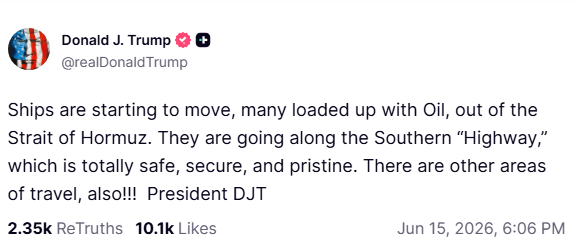
Washington (Web Desk): US President Donald Trump on Monday stated that oil tankers had begun leaving the Strait of Hormuz after Washington and Tehran reportedly reached an understanding aimed at ending the conflict.
“Ships are starting to move, many loaded up with Oil, out of the Strait of Hormuz. They are going along the Southern ‘Highway,’ which is totally safe, secure, and pristine,” Trump wrote on his Truth Social account. “There are other areas of travel, also!!!”
US Vice President JD Vance said that the United States held substantial leverage in its negotiations with Iran and expressed confidence that the upcoming round of talks would deliver a positive outcome. Speaking to CNBC, he described an agreement favorable to Americans as the “best outcome,” adding that such a position had effectively already been secured.
Referring to the expected diplomatic round later in the week, Vance said a wide range of representatives would be involved in Friday’s discussions. He added that communication with Iran had evolved under the current leadership, with both direct and indirect channels being used, which he said had changed the nature of engagement.
“We expect to have a full spectrum of representatives at the negotiation on Friday. Again, we've been talking to these people sometimes indirectly, but sometimes directly, and that's what's fundamentally changed under the president's leadership.”
He further noted that the US was now engaging Iran directly and claimed that working-level relationships had improved. According to him, clearer communication had strengthened the process of understanding each side’s intentions and seriousness.
“This is going to be a successful negotiation,” he said, arguing that direct dialogue allowed Washington to better assess reality from misinformation or hesitation.
Vance also highlighted what he described as strong US leverage, stating that Washington held the upper hand in the talks. “We fundamentally have all the cards here,” he said, adding that Iran would receive no concessions unless it committed to long-term nuclear restrictions. He further claimed Iran’s military capacity had been significantly weakened, the Strait of Hormuz was now open, and that the United States had expanded its economic pressure compared to the previous year and a half.
He also said Washington remained willing to improve relations if Tehran changed its stance. “If you guys want to meet us, if you guys want to change your relationship with the United States, we will change our relationship with Iran. That's the offer. We're going to have to see whether they meet us there.”
Addressing concerns about Israel’s response to any potential agreement, Vance suggested that parts of the Israeli establishment were supportive of the deal and claimed there had been inaccurate reporting around it. He added that the administration intended to release the agreement text soon and said it could contribute to regional stability and potentially shape a “new Middle East” lasting beyond the short term.
On the Iranian side, Foreign Ministry spokesperson Esmaeil Baghaei said that those responsible for initiating the conflict had suffered a major defeat. He also confirmed that respect for Lebanon’s sovereignty and territorial integrity was included in the interim understanding reached with the United States.
Baghaei stated that the final arrangement for signing the memorandum of understanding would be decided within one to two days, with an official announcement to follow. He also noted that diplomatic visits across the region were planned ahead of the signing ceremony in Switzerland.
He further said that the United States would be required to facilitate access to Iran’s frozen assets, while clarifying that no direct financial transfer to Tehran would be made. He added that Iran, in coordination with Oman and other regional partners, would take steps to ensure safe navigation in the Strait of Hormuz for a limited period, subject to US compliance with agreed obligations.
Baghaei warned that if Washington failed to fulfill its commitments, Iran would respond with reciprocal measures. He also pointed to deep-rooted mistrust between the two countries, citing the 1953 overthrow of Iran’s elected government as a defining historical grievance that continues to shape relations.
Iran’s Foreign Minister Abbas Araghchi, meanwhile, said during separate telephone conversations with the foreign ministers of Iraq, Egypt, and Saudi Arabia that the United States would be responsible for implementing the draft memorandum with Tehran, and urged an end to Israeli military strikes in Lebanon.
According to Iran’s state news agency IRNA, he and his counterparts also stressed the importance of sustained diplomatic engagement in order to preserve regional peace and stability.
Neo News | Copyright © 2026