Thu, September 17, 2026
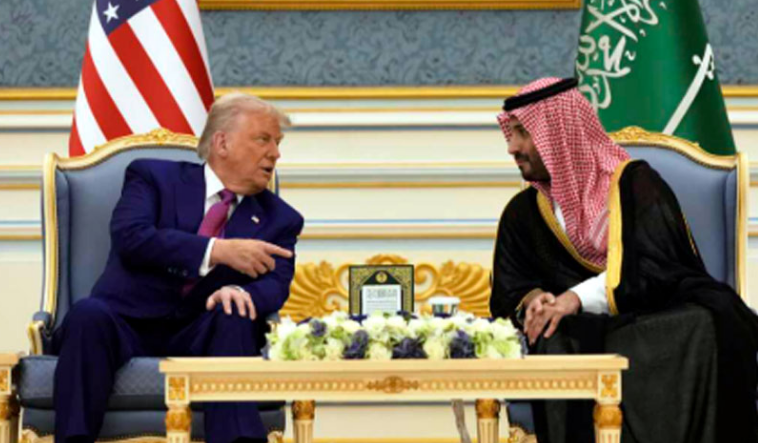
Riyadh (Web Desk/Agencies): US President Donald Trump on Tuesday finalized a landmark $142 billion arms deal with Saudi Arabia during his first full day in Riyadh.
The deal, which represents the largest arms sale in US history, is part of a broader $600 billion investment initiative between the two countries.
The defense package includes cutting-edge equipment from over a dozen US firms, aimed at enhancing Saudi Arabia’s air and missile defense systems, naval capabilities, border security, and military communications. Among the expected components are THAAD and Patriot missile systems, surveillance drones, and possibly F-35 fighter jets, pending export clearance.
In addition to the arms agreement, the two nations announced major investments across several sectors. Saudi tech firm DataVolt committed $20 billion to develop artificial intelligence centers in the US, while American companies such as Google, Oracle, Salesforce, AMD, and Uber pledged a combined $80 billion in technology partnerships.
Several US engineering firms—Hill International, Jacobs, Parsons, and AECOM—will take on $2 billion worth of infrastructure projects in Saudi Arabia, including work on King Salman International Airport. GE Vernova will deliver $14.2 billion in turbines and energy solutions. Boeing will sell 737-8 passenger jets worth $4.8 billion to Saudi aviation lessor AviLease. Saudi-based Shamekh IV Solutions will invest $5.8 billion in a new manufacturing facility in Michigan.
At the investment forum, Trump promoted the Middle East’s transformation as a result of regional leadership rather than foreign intervention. He emphasized that the rapid development in Riyadh and Abu Dhabi had come from within, not from Western-driven nation-building. Turning to Iran, he offered its leaders a path toward a more hopeful future.
High-profile business figures in attendance included Elon Musk, who discussed deploying large numbers of humanoid robots and autonomous vehicles, and OpenAI’s Sam Altman. Other attendees included Larry Fink of BlackRock, Stephen Schwarzman of Blackstone, Coca-Cola CEO James Quincey, Boeing’s Kelly Ortberg, and Google’s Ruth Porat. LinkedIn’s Reid Hoffman was mistakenly listed but confirmed he was not present.
Neo News | Copyright © 2026