Thu, September 17, 2026

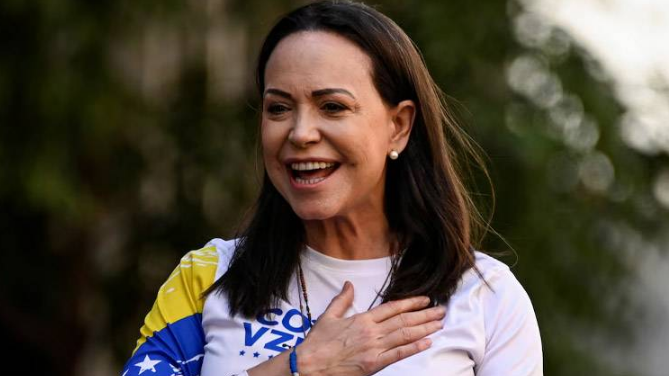
Venezuelan opposition leader Maria Corina Machado has been named the recipient of the 2025 Nobel Peace Prize in recognition of her unwavering dedication to advancing democratic freedoms and defending the rights of her people.
The Nobel Committee honored her “for her tireless work promoting democratic rights for the people of Venezuela and for her struggle to achieve a just and peaceful transition from dictatorship to democracy.”
María Corina Machado, a 58-year-old Venezuelan industrial engineer who has been living in hiding, was barred by the country’s judiciary in 2024 from entering the presidential race, preventing her from contesting President Nicolás Maduro, who has held power since 2013.
Announcing the Nobel Peace Prize, the committee remarked that recognizing those who bravely defend liberty under authoritarian regimes is vital, describing Machado as one of those who “rise and resist.”
BREAKING NEWS
— The Nobel Prize (@NobelPrize) October 10, 2025
The Norwegian Nobel Committee has decided to award the 2025 #NobelPeacePrize to Maria Corina Machado for her tireless work promoting democratic rights for the people of Venezuela and for her struggle to achieve a just and peaceful transition from dictatorship to… pic.twitter.com/Zgth8KNJk9
It is pertinent to mention that the decision came amid global attention surrounding US President Donald Trump, who has repeatedly asserted that he should receive the Nobel Peace Prize.
Trump’s name had surfaced in discussions after several countries — including Pakistan, Israel, Cambodia, Armenia, and Azerbaijan — expressed support for his candidacy.
Nevertheless, experts on the Nobel process had predicted he would not be chosen, noting that his policies have weakened the international framework that the Nobel Committee seeks to protect.
The Nobel Peace Prize, valued at 11 million Swedish crowns — roughly equivalent to $1.2 million — will be awarded in Oslo on December 10, commemorating the death anniversary of Alfred Nobel, the Swedish inventor and philanthropist who established the prize in his 1895 will.
Neo News | Copyright © 2026