Thu, September 17, 2026

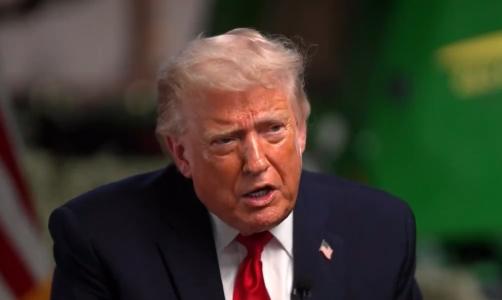
Washington (Web Desk/Agencies): US President Donald Trump has stated that Washington would collaborate with Iran on recovering and dismantling its highly enriched uranium if both sides manage to reach a broader agreement aimed at ending the ongoing three-month conflict between the two countries.
Speaking in an interview with NBC News, he said that no Iranian sanctions would be eased and no frozen assets released prior to the conclusion of a formal peace agreement. He stressed that such measures would only follow a deal. “Comes after,” he said. "Yeah. If they behave, if they do a good job, we start talking. Yeah."
.@POTUS: "I don't like these endless wars. This is not an endless war. We've been doing this for three months; much of it has been under a pretty good form of ceasefire." pic.twitter.com/ZKAIsMfRCg
— Rapid Response 47 (@RapidResponse47) June 7, 2026
During the same interview, Trump also addressed regional expectations, saying the United States was not insisting that Lebanon be included in any immediate understanding with Tehran. "I think they'd like to see it, but I'm not demanding," he said.
He further claimed that negotiations were nearing a breakthrough, while warning of severe consequences if diplomacy failed. "We're very close to a deal, or I'm going to blow the hell out of them," he said.
Trump also expressed openness to communicating with Iran’s leadership, including Supreme Leader Ayatollah Mojtaba Khamenei, who has reportedly been absent from public view since being injured during early-stage strikes in the conflict. "I don't want to say whether or not I know where he is, but there's a good probability that I do," he said.
Separately, US Secretary of State Marco Rubio has stated that a limited ceasefire framework remains in place despite continued hostilities, describing recent US actions as defensive responses rather than escalation.
The diplomatic and financial discussions, US officials are reportedly considering plans to channel Iranian funds through Gulf nations to support reconstruction and repair of damage in regional states affected by the conflict. Treasury Secretary Scott Bessent has instructed teams to evaluate the overall cost of destruction linked to Iranian attacks and potential compensation mechanisms.
These discussions follow remarks from Mohsen Rezaei, an adviser to Iran’s supreme leader, who told CNN that progress toward a peace deal depends on the release of around $24 billion in Iranian assets currently frozen by the United States. The specific nature of the assets under review has not been publicly clarified, and officials have not confirmed whether they are limited strictly to blocked funds.
The proposal to redirect Iranian-linked financial resources toward reconstruction in Gulf states is being viewed as a potential new pressure point in already fragile negotiations, which have faced repeated disruptions amid ongoing military exchanges.
Meanwhile, the diplomatic channels remain partially active, with reports that a Pakistani minister recently visited Tehran carrying a formal message addressed to Iran’s leadership, according to Iran’s semi-official ISNA news agency.
On the security front, US forces carried out strikes on Iranian coastal radar installations in Goruk and Qeshm Island, both located near the Strait of Hormuz, following the interception of drones that US Central Command said posed a threat to maritime traffic. Additional Iranian drones were also shot down by US forces during the same period.
In response, Iran’s Revolutionary Guards announced retaliatory missile strikes targeting US-associated bases in Kuwait and Bahrain. While Iranian officials claimed successful hits, US military sources reported that most missiles were intercepted, with one failing to reach its target, and no casualties were confirmed, though some infrastructure damage was acknowledged.
Neo News | Copyright © 2026