Thu, September 17, 2026

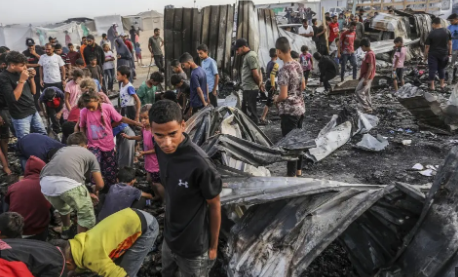
Geneva (Web Desk): Two months into a crippling aid cutoff enforced by Israeli authorities, Gaza has plunged deeper into humanitarian despair, with food supplies exhausted and residents clashing over access to dwindling water resources under relentless military bombardment.
The UN Office for the Coordination of Humanitarian Affairs (OCHA) has painted a grim picture of the unfolding crisis.
Olga Cherevko, an OCHA representative speaking from Gaza City, relayed the desperate conditions during a press briefing in Geneva. She recounted harrowing scenes, including an incident where individuals caught in explosions were left to burn because there was no water available to extinguish the flames.
According to Cherevko, since March, all cargo access into Gaza has been shut off by Israeli authorities, initiating what aid workers feared would be the worst possible outcome: supplies running out as violence escalates.
She described the situation as catastrophic, with food stocks now essentially gone and clean water unattainable.
From her location in Gaza City, she could witness violent confrontations breaking out over water; just below her window, people were reportedly hurling stones and even firing at a truck as it tried to drive off with water.
Every day, she sees children whose lives have been shattered, their innocence stolen by months of war, and elderly residents scouring trash heaps in hopes of finding scraps of food or material to burn in makeshift fires, with no fuel left for cooking.
During a recent visit to a pediatric facility—Patient Friends Hospital, which has sustained multiple attacks during the ongoing conflict—Cherevko heard direct reports of a steep rise in child malnutrition.
Hospitals across Gaza are sounding the alarm: blood supplies have run dry while waves of casualties continue to overwhelm emergency rooms. Fuel shortages have forced strict rationing, and medical staff are operating under extreme conditions.
Malnutrition among children is becoming increasingly severe, a direct result of the complete collapse of food distribution.
According to Cherevko, Gaza is dangerously close to total collapse. She emphasized that the UN remains in active communication with Israeli officials and stands ready to resume large-scale aid deliveries as soon as border access is restored.
She assured that rigorous mechanisms are in place to prevent aid from being misused and to ensure it reaches the intended recipients. The humanitarian agencies, she said, are committed to staying on the ground, providing assistance wherever it's needed most.
On Thursday, UN humanitarian chief Tom Fletcher made a direct appeal to Israeli authorities, urging them to end the blockade and allow life-saving assistance to resume. Fletcher also reiterated the importance of freeing the hostages taken by Hamas on October 7, 2023, stating that civilian lives and humanitarian aid must never be used as leverage in conflict.
Cherevko reported that over the past six weeks, nearly half a million people have again been forced to flee their homes, many of them coming under fire as they fled with nothing but the clothes they wore.
These displaced families are now crowding into shelters already overwhelmed, many of which have also come under attack. Some have tried to take refuge in tents or makeshift encampments, which have also been bombed.
Reflecting on the magnitude of the suffering, Cherevko expressed a fear that in years to come, the world will look back on this period with shame, unable to justify the inaction in the face of such horror.
The UN High Commissioner for Human Rights, Volker Türk, issued a separate call for immediate international intervention to halt the collapse of humanitarian infrastructure in Gaza.
As the full blockade stretches into its ninth week, Türk stressed the need for urgent global efforts to prevent an even more catastrophic outcome.
Gaza’s bakeries have shut down due to the exhaustion of flour and fuel supplies, and any remaining food reserves are rapidly disappearing.
Türk warned that starving civilians as a method of warfare is not only inhumane but a clear violation of international law and constitutes a war crime. He also condemned any form of collective punishment.
He expressed alarm over reported Israeli plans to declare the Rafah governorate in southern Gaza a designated “humanitarian zone,” which would require Palestinians to relocate in order to access food and aid.
Türk warned that this strategy would likely leave large swaths of the population—especially the sick, elderly, disabled, and those caring for families—stranded without assistance.
Even as these concerns mount, Israeli airstrikes continue across Gaza, including areas previously identified as safe zones for displaced people. Between March 18 and April 27, the UN’s human rights office documented 259 strikes on homes and 99 on tent camps housing internally displaced persons.
The majority of these attacks resulted in fatalities, including many women and children. Particularly concerning are the 40 reported strikes on tent encampments in Al-Mawasi, a coastal strip repeatedly designated by the Israeli military as a safe refuge for civilians.
Neo News | Copyright © 2026