Fri, September 18, 2026

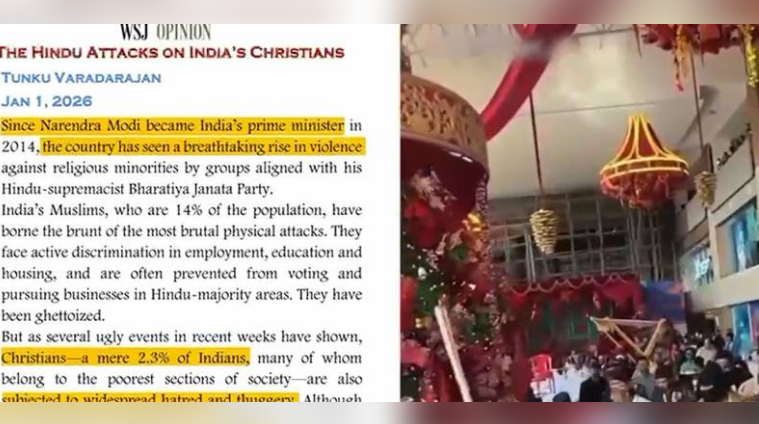
New York (Web Desk): Since Narendra Modi took office as India’s prime minister in 2014, attacks on religious minorities have escalated sharply, particularly by groups connected to his Hindu-nationalist Bharatiya Janata Party.
Muslims, who make up roughly 14% of India’s population, have often been the most visible victims, facing violent assaults alongside systemic discrimination in jobs, education, housing, and even voting. Many are effectively confined to segregated neighborhoods. But recent events show that Christians, though a small minority at 2.3% of the population and largely poor, are also enduring widespread hostility and targeted violence.
Radical Hindu groups, despite representing a fraction of the country’s 80% Hindu majority, are obsessed with what they perceive as a threat from Christianity. Around a dozen Indian states have laws limiting religious conversion through “force, fraud, or allurement,” the last term often interpreted broadly to include any evangelical effort. Violence against Christians is frequently justified as preventing such conversions.
Christmas, long a public holiday in India alongside Hindu, Muslim, and Sikh observances, has become a point of tension. In Uttar Pradesh, BJP chief minister Yogi Adityanath challenged the holiday by keeping schools open, while mobs gathered outside churches on Christmas Eve, shouting Hindu prayers and slogans like “Death to Christian missionaries” during services.
Videos circulated widely online showed similar incidents across the country. In Madhya Pradesh, a BJP leader disrupted a church Christmas meal and assaulted a young blind woman, accusing her of promoting conversions. In Raipur, Chhattisgarh, extremists attacked Christmas displays in a mall, decapitating Santa Claus figures with iron rods. Reports of such attacks emerged from nearly every BJP-ruled state.
Human-rights organization Citizens for Justice and Peace called the holiday season “a national flashpoint for majoritarian assertion” and described the mall attack as “symbolic violence—an effort to make Christian presence in public spaces unacceptable.” According to the United Christian Forum, attacks on Christians rose from 139 incidents in 2014 to 834 in 2024, with 706 recorded by November 2025.
The US Commission on International Religious Freedom recommended in 2025 that India be designated a “country of particular concern” due to widespread religious freedom violations left unchecked, citing multiple cases of attacks carried out with impunity.
In August 2024, more than 200 Hindu extremists attacked 18 Christian families in Chhattisgarh while police failed to intervene. The previous December, eight village councils in the state required Christians to renounce their faith or leave.
This past Christmas, Modi attended Mass at the Cathedral Church of the Redemption in New Delhi, calling it “a celebration of love, peace, and compassion” and urging that the spirit of Christmas inspire harmony and goodwill.
For many Christians and secular citizens, his words rang hollow. Outside the capital, in towns far removed from New Delhi’s cosmopolitan image, mobs of Hindu radicals carried out attacks with impunity.
India’s constitutional secularism, established in 1950, has always had limits—a legal framework imposed on a society with deep sectarian currents. Before Modi, governments generally made at least some effort to restrain majoritarian extremism and curb Hindu chauvinism. Under Modi, those checks have largely disappeared.
While his defenders argue that it is impossible to control every extremist in a country of India’s size, critics note that nothing prevents him from condemning such acts and declaring that violence against religious minorities is unacceptable in a civilized society.
Neo News | Copyright © 2026