Fri, September 18, 2026

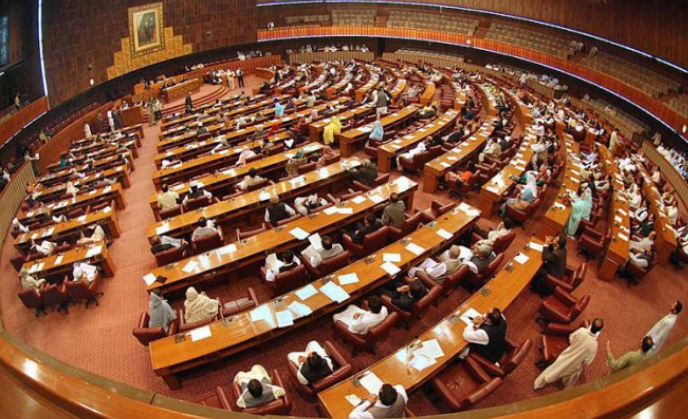
Islamabad (Web Desk): The National Assembly on Tuesday echoed with calls for political solidarity uncompromising action against militancy and a well-rounded strategy to confront the deeper causes of unrest, as lawmakers held a detailed discussion on the country’s law and order situation, with Balochistan at the center of concern.
The debate was triggered by a motion presented by Minister of State for Interior and Narcotics Control Muhammad Tallal Badar.
The MNAs from various political parties contributed to the conversation, examining the issue from security, political and societal angles.
Speaking during the session, MNA Aliya Kamran underscored the need for national cohesion to counter what she described as foreign-backed attempts to destabilize Pakistan.
She tied the nation’s security and economic progress to the defense of its sovereignty and, referencing recent regional events, alleged that after suffering a setback in the so-called “Operation Sandoor,” India was now trying to create instability within Pakistan.
She argued that only a united national front and the rejection of hostile narratives could effectively confront such threats, adding that Pakistan’s security forces continued to serve as the first line of defense against external plots.
MNA Aliya Hamza Malik condemned terrorism in all its manifestations and urged a closer look at the root drivers behind militancy.
She noted that increasing radicalisation, including the reported involvement of women in suicide bombings, signaled the need to better understand the recruitment methods and operational structures of extremist networks.
Highlighting the importance of dialogue and community-based measures, she warned that neglecting the situation in Balochistan could lead to serious and far-reaching consequences.
MNA Sofia Saeed stressed the importance of firm and decisive action against militants as well as those who support them. She said improving the country’s security landscape required stronger preventive frameworks and better coordination among relevant institutions to safeguard citizens.
MNA Ijaz ul Haq observed that unrest in Balochistan was a long-standing challenge and should not be treated as a minor or temporary issue.
Calling the recent violence a coordinated security test, he advocated reconciliation and meaningful engagement with local populations instead of negotiations with armed groups.
He emphasized the need for a consistent and well-defined policy that addresses the underlying causes of conflict while firmly maintaining the authority of the state.
MNA Hina Rabbani Khar said enduring peace in Balochistan could only be achieved by understanding the province’s situation through the perspective of its people.
She stressed the need to listen carefully to local voices and to acknowledge the daily hardships faced by communities on the ground.
MNA Mirza Ikhtiar Baig strongly denounced the recent terrorist attack in Balochistan and paid tribute to the Pakistan Army for successfully eliminating the attackers. He also called for complete and nationwide implementation of the National Action Plan.
MNA Sabheen Ghoury pointed out that eliminating the sense of deprivation felt by many in Balochistan was crucial for long-term stability.
She maintained that dialogue remained an essential tool for addressing longstanding grievances.
MNA Noor Alam Khan highlighted the heavy toll of violence in Khyber Pakhtunkhwa, saying both civilians and security personnel were losing their lives on a daily basis.
He added that frequent attacks on educational institutions were severely disrupting learning, especially for women and children.
Rejecting any differentiation between so-called “good” and “bad” militants, he asserted that anyone targeting Pakistan, its armed forces or its schools should be dealt with strict and decisive action.
Wrapping up the discussion, the House collectively emphasized the importance of unity, coordinated policy responses and sustained commitment to restoring peace and stability, particularly in regions that have been most affected by conflict.
Neo News | Copyright © 2026