Fri, September 18, 2026

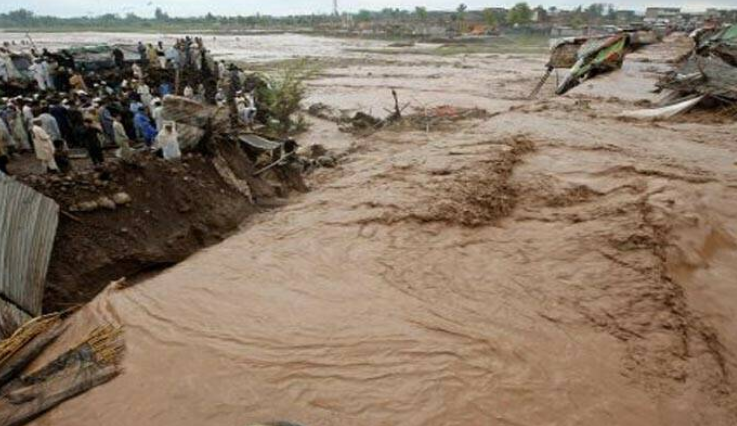
Lahore (Web Desk): Punjab is currently grappling with an intensifying flood crisis as the Chenab, Ravi, and Sutlej rivers have surged to extremely high levels, threatening large expanses of land across the province.
The Provincial Disaster Management Authority (PDMA) has warned of further torrential rainfall that could lead to serious urban flooding, particularly in the cities of Lahore, Gujranwala, and Gujrat.
In a significant development, the High Commission of India has informed Pakistani authorities that floodwaters from the Harike and Ferozepur headworks are heading downstream, further raising the threat level. This information was shared by the Pakistan Commission for Indus Waters, which confirmed that the Sutlej River is already at dangerously high flood levels as of 8 am on September 1, with impacts expected downstream in various districts.
This warning coincides with continuous and heavy rainfall across northern India, especially in the catchment zones of rivers that flow into Pakistan. Weather forecasts suggest that the next 36 hours are critical for the Indian regions of Uttarakhand, Himachal Pradesh, Haryana, and Punjab, where more heavy rain is predicted.
Back in Pakistan, by 1 am on Tuesday, the Chenab River at Trimmu recorded a large and stable outflow of 532,498 cusecs—categorized as a very high flood. A dangerous wave of water is moving toward Head Trimmu, where water levels are projected to rise close to 700,000 cusecs.
At the same time, the Ravi River is facing a similar situation. At Balloki Headworks, the river is flowing at 144,675 cusecs, while the Sidhnai Headworks is also under heavy strain, showing a rising trend from its current 105,604 cusecs.
Meanwhile, the Sutlej remains a significant danger at Ganda Singh Wala, maintaining an exceptionally high flood level with consistent flows of 253,068 cusecs. Projections indicate the situation could worsen, with approximately one million cusecs expected to converge at Panjnad between September 4 and 5.
As the flood crisis worsens, the provincial government is shifting its attention toward southern Punjab. On Monday, Punjab Information Minister Azma Bokhari stated that multiple districts were on high alert for the coming 24 to 48 hours. The areas under immediate threat include Jhang, Sahiwal, Toba Tek Singh, Okara, Multan, Pakpattan, Bahawalnagar, Vehari, and Bahawalpur.
Speaking in Lahore, she stressed that the water release from India has created extraordinary circumstances, and the provincial government is responding with extraordinary measures. She added that rescue teams and civil defence personnel have been fully mobilized for any emergency response.
In another press briefing, PDMA Director General Irfan Ali Kathia revealed that the ongoing floods have resulted in 41 fatalities and eight injuries. He noted that Punjab is dealing with what could be the largest flood in its recorded history. The ninth spell of the monsoon is expected to bring more rain in the next two days.
While there is no new flood surge reported at Head Marala for now, the Leh Nullah at Katariyyan has risen significantly, reaching 19 feet due to rainfall. Although there is no immediate threat to Trimmu Headworks, water from the Chenab is expected to enter Multan within 12 hours, where it will combine with floodwaters from the Ravi.
Kathia mentioned that a breach might be necessary at Safura due to the increasing water pressure at Sidhnai. Preparations for the breach have been finalized, and if carried out, it will affect 14 villages and around 17,000 acres of land. Additionally, a surge of 600,000 to 650,000 cusecs is anticipated at Head Muhammad Wala on Tuesday. A key meeting on this matter has already been held in Multan, and important decisions have been taken, including possible breaching operations. If a breach is executed at this site, around 16 mouzas will be impacted.
The PDMA chief said that floodwaters are likely to reach Panjnad by September 5, though at slightly lower levels than previously estimated. Currently, water from the Sutlej is heading toward Sulemanki and Head Islam. He emphasized that timely decisions have saved many lives and pointed out that Rescue 1122 is leading the largest rescue effort in Punjab’s history. So far, about 3,100 villages and 2,900 revenue estates have been affected throughout the province.
According to the PDMA, more than 2.4 million people have been impacted by the floods, with over 900,000 people and 600,000 animals relocated to safe areas. Relief operations are ongoing, including the establishment of 390 relief camps and tent cities. The Livestock Department is actively providing feed and fodder for displaced animals. Kathia also criticized India for sharing information only regarding the Sutlej and not about other rivers, leaving authorities less prepared for incoming surges from the Ravi and Chenab.
He also confirmed that there is no current expectation of a major surge at Marala, but rain-induced runoff will still affect the area.
Earlier, Multan Commissioner Aamir Karim Khan confirmed that over 450,267 people and 468,284 livestock had been moved to safer locations. He warned that a major flood wave of around 800,000 cusecs in the Chenab was likely to pass through Multan between Monday and Tuesday night. Decisions about possible breaches at Sher Shah and Head Muhammad Wala would be made depending on the evolving water situation.
Meanwhile, the PDMA has projected very high to exceptionally high flood conditions in the Sutlej, Ravi, and Chenab rivers. Local district administrations have been instructed to prepare for emergencies, take proactive measures, and keep the public informed through all available communication channels.
Neo News | Copyright © 2026