Thu, September 17, 2026

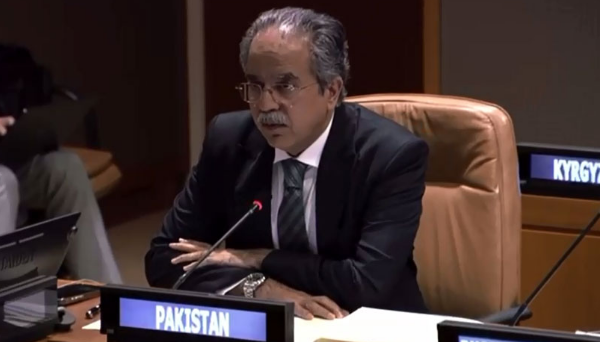
New York (Web Desk): Pakistan has called on the international community to take immediate action to halt Israel’s military operations in Lebanon and to intensify diplomatic efforts aimed at preventing further escalation.
The appeal was made during an emergency session of the United Nations Security Council (UNSC) convened amid growing tensions along the Lebanon-Israel border.
Speaking before the 15-member body, Pakistan’s Permanent Representative to the United Nations, Asim Iftikhar Ahmad, emphasized that a lasting solution to the conflict could only be achieved through meaningful dialogue and diplomacy.
He also acknowledged the United States’ role in helping broker a ceasefire between Lebanon and Israel and expressed support for continued efforts to preserve and strengthen the truce.
The emergency meeting, requested by France, took place after Israeli forces advanced deeper into Lebanese territory, including the strategic Beaufort Castle area, while Hizbullah stepped up its missile, drone and rocket attacks against Israel.
Highlighting the deteriorating conditions on the ground, Ambassador Ahmad said that despite ceasefire arrangements and direct communication between Lebanon and Israel, the security and humanitarian crisis continues to worsen.
He noted that Israeli military operations and ground incursions have expanded significantly, leaving nearly 2,000 square kilometres—around one-fifth of Lebanon’s territory—under what he described as unlawful occupation, causing severe suffering among civilians.
The Pakistani envoy remarked that the developments reflected a pattern witnessed in other conflict zones, marked by indiscriminate violence, forced displacement and territorial occupation.
He informed the Council that since March, more than 3,400 people, including women and children, have lost their lives, over 10,000 have been wounded and more than one million people have been forced from their homes.
Asim also expressed concern over attacks targeting humanitarian and medical personnel, stating that 125 healthcare workers had been killed and more than 300 injured during the same period.
The Pakistani envoy praised Lebanon’s efforts to restore stability, strengthen state institutions and ensure that the authority to use force remains solely with legitimate state bodies, particularly the Lebanese Armed Forces.
Reaffirming Pakistan’s position, he called for full respect for Lebanon’s sovereignty and territorial integrity, an immediate halt to hostilities, strict observance of the ceasefire by all parties and the implementation of UN Security Council Resolution 1701, including Israel’s complete withdrawal to the Blue Line separating the two countries.
He concluded by reiterating Pakistan’s unwavering support for Lebanon and its people, while pledging continued backing for initiatives aimed at fostering peace, stability and security across the region.
Opening the Council discussion, Martha Ama Akyaa Pobee, Assistant Secretary-General for Political and Peacebuilding Affairs and Peace Operations, described the situation in Lebanon as extremely troubling.
She reported that Israeli ground troops had continued their advance northward inside Lebanese territory, while Hizbullah had expanded the reach of its attacks into Israel.
According to Pobee, recent Israeli military actions included the capture of Beaufort Castle, advances beyond the Litani River in the Yohmor triangle, intensified air strikes across southern Lebanon, the Beqaa Valley and areas surrounding Beirut, as well as widespread evacuation warnings issued to civilians living south of the Zahrani River.
She also referred to extensive military activity documented by the United Nations Interim Force in Lebanon (UNIFIL) north of the Blue Line, including 992 projectile trajectories recorded from Israeli forces on 30 May, the highest figure since the cessation of hostilities announced on 17 April.
Pobee noted that Hizbullah has continued launching rockets, anti-tank missiles and drones, including increasingly sophisticated fibre-optic drones.
The group has also deployed surface-to-air missiles and improvised explosive devices against Israeli military personnel and equipment inside Lebanese territory, while intensifying strikes deeper into Israel in recent days.
She warned that these developments represent a serious and dangerous escalation that threatens the ceasefire understanding announced by the United States US on April 16 and risks undermining already fragile diplomatic efforts aimed at reducing tensions.
France’s Ambassador to the United Nations, Jerome Bonnafont, who requested the Security Council meeting, said there was no justification for the continuation or scale of Israel’s military operations in Lebanon.
He pointed to the heavy civilian death toll, widespread injuries, mass displacement and the expanding occupation of Lebanese territory as deeply concerning developments.
Describing Israel’s actions as a major strategic error, Bonnafont argued that they contradict the commitments undertaken on 17 April as well as obligations arising from Security Council resolutions.
Stressing the urgency of ending the violence, he said the symbolic raising of the Israeli flag over Beaufort Castle on Sunday reflected a return to a chapter many believed had ended with Israel’s withdrawal from southern Lebanon in 2000.
Warning against repeating the mistakes of the past, the French envoy said history has repeatedly shown that similar actions often produce similar consequences, underscoring the need for an immediate end to the fighting and renewed diplomatic engagement.
Neo News | Copyright © 2026