Thu, September 17, 2026

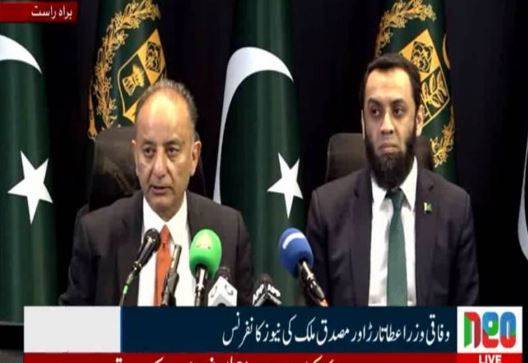
Islamabad (Web Desk): Federal Minister for Information and Broadcasting Attaullah Tarar said on Monday that Pakistan will host its first international seminar on the Indus Waters Treaty (IWT) on Tuesday in Islamabad, bringing together leading water and legal experts from around the world to discuss Pakistan’s rights under the agreement.
Speaking at a joint press conference with Climate Change Minister Dr Musadik Malik, the minister said that experts from various countries had already arrived in Pakistan to participate in the seminar.
He added that the event would highlight Pakistan’s legal rights over its rivers under the treaty, along with its legal framework and broader dimensions.
Tarar said Pakistan’s longstanding stance on the Indus Waters Treaty has received international recognition and endorsement, noting that the global community acknowledges water security as a critical issue for Pakistan and accepts its legal rights under the agreement.
He maintained that the Indus Waters Treaty cannot be revoked, suspended, or terminated unilaterally by any party, nor can it be amended by one side alone.
He said the treaty provides a clear legal framework that remains in force and is continuously implemented.
The minister said Prime Minister Shehbaz Sharif has consistently described water as Pakistan’s lifeline and a “red line,” while Field Marshal Syed Asim Munir has also reiterated the same position at various forums.
He emphasized that Pakistan’s people have a legal right to receive water under a binding treaty that remains valid and enforceable between both countries.
Tarar further said that India has faced criticism at several international platforms over its stance on the treaty, adding that its position has not been accepted globally.
He claimed that international experts, when examining the issue objectively, have acknowledged Pakistan’s legal position.
He described the seminar as part of efforts to raise global awareness of Pakistan’s rights under the Indus Waters Treaty and to strengthen its narrative at the international level.
Responding to questions, the minister said the government is actively working on environmental protection, including measures to safeguard forests and address climate change impacts.
He noted that Pakistan managed recent flood relief and rehabilitation efforts through its own resources without seeking international assistance.
He said action is being taken against deforestation through enforcement measures and issuance of notices, while tree plantation remains a priority for both federal and provincial governments.
Tarar highlighted that Pakistan is among the countries most vulnerable to climate change despite contributing less than one percent to global greenhouse gas emissions. He reaffirmed the government’s commitment to climate resilience and environmental protection.
He added that Pakistan has consistently raised its concerns on climate change at international forums, including the United Nations General Assembly, and has informed global partners about the heavy economic losses caused by climate-related disasters.
He also said Pakistan independently managed relief and rehabilitation efforts during recent floods, rebuilding affected communities through domestic resources, reflecting improved economic stability and self-reliance.
The minister concluded that Pakistan continues to extend humanitarian assistance to other countries during times of disaster.
Neo News | Copyright © 2026