Wed, September 16, 2026

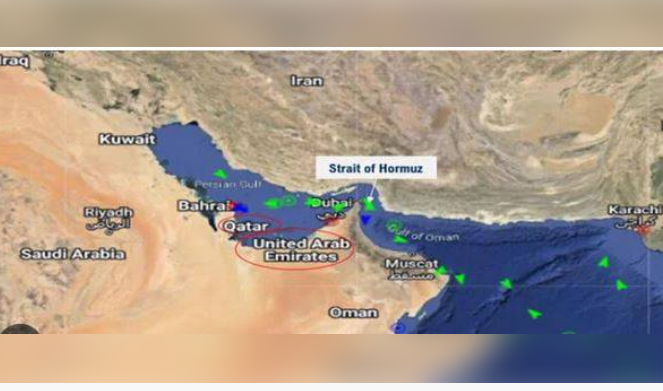
Tehran (Web Desk/Agencies): Tensions in the Middle East escalated on Tuesday as Iran issued a Notice to Airmen (NOTAM) warning of live-fire military exercises near the Strait of Hormuz, coinciding with the arrival of US military forces in the region.
The advisory states that Iranian troops will conduct the drills from January 27 to 29 within a five-nautical-mile zone surrounding the strategic waterway. The affected airspace, from the ground up to 25,000 feet, will be temporarily restricted and considered hazardous for all flights.
The Strait of Hormuz is a critical artery for global trade, with millions of barrels of oil passing through daily. Any interruption in its operations tends to unsettle energy markets worldwide and raises alarms across the international community.
The NOTAM comes at a time when the US has ramped up its military presence. US Air Forces Central (AFCENT) announced a multi-day readiness exercise in the region, aiming to demonstrate rapid deployment and operational sustainability.
Washington officials have made clear that all options, including military measures, remain available to counter Iran’s regional influence. In response, Iranian authorities warned that any attack would trigger a “swift and comprehensive” retaliation.
Civilian and military flights will need to navigate the temporary restrictions during the live-fire drills, a standard precautionary measure issued in advance of such exercises.
Among the US forces moving into the region is the aircraft carrier USS Abraham Lincoln, accompanied by several guided-missile destroyers.
Officials told Reuters that these vessels entered the Middle East under US Central Command.
Former President Donald Trump described the fleet in a public address, saying, “There is another beautiful armada floating beautifully towards Iran right now.”
These warships had been deployed from the Asia-Pacific earlier this month amid growing tensions following Iran’s crackdown on nationwide protests.
Trump had previously threatened intervention if the killings continued but later indicated that violence had subsided and there were no immediate plans for prisoner executions.
Historically, the US has increased its military presence in the Middle East during periods of heightened tensions, typically as a defensive measure.
Last year, Washington staged a significant buildup before June strikes targeting Iran’s nuclear facilities. In addition to the naval forces, the Pentagon is relocating fighter jets and air-defense systems to the area.
Meanwhile, Israeli Prime Minister Benjamin Netanyahu remarked that “Trump will decide what he decides; the State of Israel will decide what it decides,” warning that any attack by Iran would be met with unprecedented force.
Iranian President Masoud Pezeshkian condemned US “threats” in a call with Saudi Crown Prince Mohammed bin Salman, describing them as attempts to destabilize the region and achieve nothing but insecurity.
The US maintains several bases throughout the Middle East, prompting a senior commander of Iran’s Revolutionary Guards to issue a caution to neighboring nations.
Mohammad Akbarzadeh, political deputy of the IRGC naval forces, told Fars news agency that while Iran considers its neighbors friends, any use of their soil, airspace, or waters against Iran would be treated as hostility.
A senior Iranian official, speaking anonymously, warned that Tehran would consider any attack an “all-out war.” The official stressed that while the military hopes the current US buildup is not meant for direct confrontation, Iran’s forces are on high alert.
“This time we will treat any attack — limited, unlimited, surgical, kinetic, whatever label it carries — as an all-out war against us, and we will respond in the harshest way possible,” the official said.
Saudi Arabia and the United Arab Emirates have reassured Iran that their territories, airspace, and waters will not be used for military actions against the Islamic Republic.
The US airbase at Al Dhafra, south of Abu Dhabi, remains a crucial hub for the US Air Force, supporting operations against the Islamic State and conducting reconnaissance missions across the region.
Neo News | Copyright © 2026