Sat, September 26, 2026

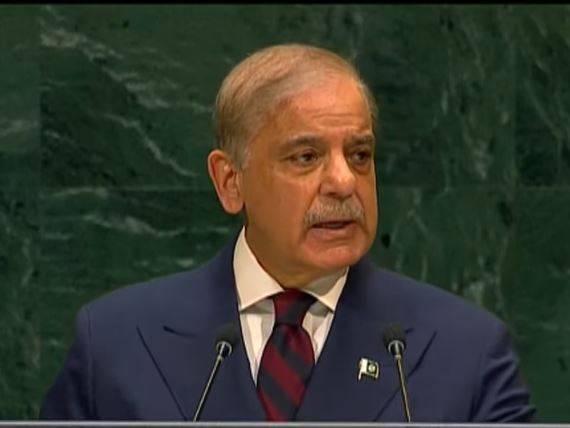
New York (Web Desk): Prime Minister Shehbaz Sharif has urged the international community to ensure that the Straits of Hormuz and Bab al-Mandeb remain accessible, calling the strategically important waterways “arteries of the global economy” as tensions across the region continue to intensify.
Addressing the 81st session of the United Nations General Assembly on Friday, the prime minister said diplomatic efforts must take precedence over conflict as the region faces the “roar of missiles, drones, and guns”.
“The Straits of Hormuz and Bab al-Mandeb are arteries of the global economy. They must remain open — connecting nations, not becoming choke points of confrontation,” he said.
The remarks came after US and Israeli strikes on Iran, following which Tehran initially shut the Strait of Hormuz. Several months into the conflict, the Houthis also began interfering with maritime traffic passing through the Bab al-Mandeb Strait, adding to pressure on energy prices.
“These waters must carry the promise of prosperity, not the perils of war,” the prime minister added.
Sharif also strongly denounced what he described as recent “deplorable attacks” by the Houthis against Saudi Arabia.
He said the attempted drone strike targeting the holy city of Makkah had “outraged Muslims across the globe”, and emphasized that any danger to the security and sanctity of the Haramain Sharifain represented a “red line that must never be crossed”.
“No Muslim can even dare to think of committing such a heinous crime. Pakistan stands in complete solidarity with the brotherly people of Saudi Arabia, as we always have throughout our history,” Shehbaz said.
The prime minister referred to the Makkah Joint Defence Agreement involving Saudi Arabia, Turkiye and Pakistan, saying the arrangement demonstrated the three countries’ shared resolve to promote peace.
“This alliance is not directed against any country. It is a collective commitment for defence, stability, and peace in the region, and nothing more,” he said.
On the Indus Water Treaty, Shehbaz described water as the “lifeblood” of Pakistan as well as the wider region and warned that any effort to block, obstruct or divert Pakistan’s portion of the river waters would be considered an “act of war”.
He said India’s unilateral move to place the existing water agreement in abeyance had “no legal basis whatsoever”. According to the prime minister, India’s position and subsequent actions had been rejected by experts and, more recently, by the Court of Arbitration.
PM Shehbaz maintained that Pakistan’s assertion that the treaty remains “valid, binding and fully operative” had been vindicated.
“Water must never be weaponised. Rivers should nourish nations, not divide them,” he said.
He cautioned India against taking any action affecting Pakistan’s water allocation and reiterated that Islamabad would view such interference as an act of war.
The prime minister said Pakistan exercised its right to self-defence under Article 51 of the United Nations Charter in May last year, when its armed forces responded to an Indian attack under the leadership of Field Marshal Syed Asim Munir.
He also attributed a role to US President Donald Trump in preventing the confrontation between the two nuclear-armed countries from expanding, saying his intervention helped save “hundreds of millions of lives” in South Asia.
Shehbaz said the region must not once again approach the threshold of a full-scale war and argued that achieving this would require a “just and fair” settlement of the Kashmir dispute.
He said Kashmiris had spent eight decades waiting for the United Nations to honour its commitment to a free and impartial plebiscite, while successive generations had faced illegal occupation, arbitrary detention, extrajudicial killings, enforced disappearances, sexual violence and collective punishment.
The prime minister alleged that efforts were being made to change the legal character of Indian Illegally Occupied Jammu and Kashmir through demographic alterations and other measures.
He assured the people of Kashmir that Pakistan would continue its diplomatic, political and moral backing until they secured their “inalienable right to self-determination”.
“Kashmir has been, and always will be, Pakistan’s jugular vein,” Shehbaz said.
Describing terrorism as among the most serious dangers to international peace and security, the prime minister said Pakistan had borne a substantial human and financial cost in confronting terrorism.
He said nearly 100,000 people had been killed in Pakistan and that the country had sustained economic losses of more than $150 billion while fighting terrorists across its cities, mountains and border regions.
The premier nsaid Afghan territory was still being used by the outlawed TTP, which Pakistan refers to as Fitna al-Khawarij, as well as the BLA, which he called Fitna al-Hindustan, for attacks against Pakistan.
He called on the Afghan authorities to honour their international obligations and undertake verifiable measures to ensure that their territory was not used to launch attacks against Pakistan or other states.
The prime minister also urged that the fundamental rights of the Afghan population, especially women and girls, be protected.
Turning to the situation in Palestine, Shehbaz condemned Israel’s actions in Gaza and the West Bank, saying Palestinians, with women, children and elderly people among those affected, had experienced occupation, displacement, suffering and death for generations.
He referred to the killing of Palestinian child Hind Rajab and also drew attention to the death of eight-year-old Wafaa Akeela, whose first day at school turned out to be her last.
The prime minister questioned whether children born in Gaza were not entitled to the same opportunities for life, hope and dreams as children living elsewhere.
Shehbaz said the deaths of Hind Rajab, Wafaa Akeela and numerous other Palestinians would remain an indictment of what he described as the international community’s silence and inaction.
He reiterated Pakistan’s support for an independent, sovereign, viable and contiguous Palestinian state founded on the pre-1967 borders, with Al-Quds Al-Sharif serving as its capital.
The prime minister additionally condemned Israeli aggression involving Lebanon and Syria and demanded an immediate cessation of the violence.
He voiced concern over the growing problem of Islamophobia, pointing to hate speech, discrimination, attacks on mosques and the desecration of the Holy Quran.
PM Shehbaz also criticized what he described as the RSS-driven Hindutva ideology in India for promoting religious hatred, communal violence and limitations on religious freedom. He cited the demolition of a 150-year-old mosque in Saharanpur as an example.
“Religious hatred must have no place in the world,” he added.
The prime minister concluded by drawing attention to Pakistan’s exposure to the effects of climate change, noting that the country produces less than 1% of worldwide emissions while repeatedly experiencing severe climate-related consequences.
He called on developed nations to honour their commitments concerning climate finance, provide resources for loss and damage, and assist vulnerable countries with adaptation and resilience measures.
Neo News | Copyright © 2026