Thu, September 17, 2026

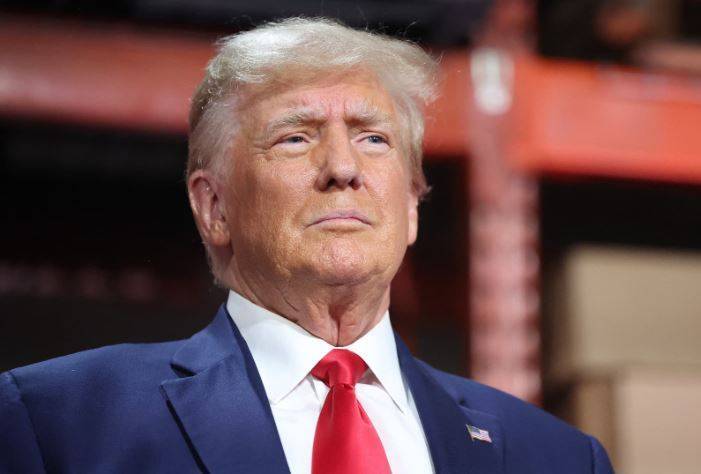
Washington (Web Desk): US President Donald Trump has said a landmark civilian nuclear agreement with Saudi Arabia will only take effect if the Kingdom joins the Abraham Accords and normalises diplomatic relations with Israel.
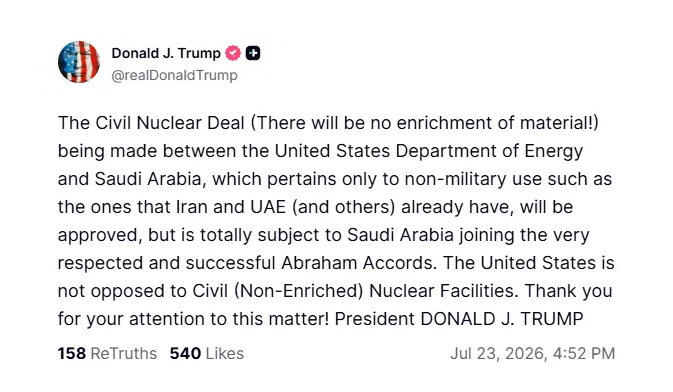
In a post on Truth Social, Trump said the proposed agreement covers only the peaceful use of nuclear technology and is limited to civilian nuclear facilities similar to those already operating in countries such as Iran, the United Arab Emirates (UAE) and others.
He said the agreement would be approved only after Saudi Arabia joins the Abraham Accords, which were brokered by the Trump administration in 2020 to normalise relations between Israel and several Arab states.
The accords, however, remain controversial in parts of the Middle East as they do not address the Israeli-Palestinian conflict.
The announcement comes as the United States remains engaged in conflict with Iran, with Tehran's nuclear programme continuing to be a major point of contention amid stalled diplomatic efforts.
The US Department of Energy said Energy Secretary Chris Wright and Saudi Energy Minister Prince Abdulaziz bin Salman signed two agreements covering peaceful nuclear cooperation and bilateral safeguards. The full text of the agreements has not yet been released.
In a statement, the department said the agreements establish the legal framework for a long-term, multi-billion-dollar partnership aimed at advancing strategic and economic interests while supporting nuclear non-proliferation.
According to a report by The Wall Street Journal, one provision could allow US companies to construct a uranium enrichment facility in Saudi Arabia. However, the Energy Department neither confirmed nor mentioned such a clause in its official statement.
The agreement will now be submitted to the US Congress for review, although it is widely expected to clear the Republican-controlled legislature without significant opposition.
The proposal has previously raised concerns among US lawmakers from both major parties as well as Israeli officials, who fear Saudi Arabia could eventually use civilian nuclear technology to develop nuclear weapons.
Saudi Arabia has consistently maintained that it has the right to pursue a peaceful civilian nuclear programme, similar to Iran's stated position.
Washington has long sought to link a civilian nuclear agreement with broader regional objectives, including Saudi Arabia's recognition of Israel and a wider US-Saudi strategic and defence partnership. Pakistan and Saudi Arabia signed a mutual defence pact in September 2025.
The United States signed a similar civilian nuclear cooperation agreement with the UAE in 2009, although Abu Dhabi does not enrich uranium domestically. Concerns over nuclear proliferation in the Gulf have intensified amid fears that an Iranian nuclear weapon could trigger a regional arms race.
US Energy Secretary Chris Wright dismissed proliferation concerns, saying the agreements uphold the highest standards of nuclear safety and non-proliferation while relying on advanced American nuclear technology and expertise.
The agreement has been concluded under Section 123 of the US Atomic Energy Act, the legal framework governing US civilian nuclear cooperation with foreign countries. The United States currently has similar agreements with more than 50 nations.
Nuclear policy experts offered mixed reactions. Matthew Kroenig of the Atlantic Council warned that allowing uranium enrichment in Saudi Arabia would weaken global non-proliferation standards despite the importance of strengthening ties with Riyadh.
Jennifer T. Gordon, director of the Atlantic Council's Nuclear Energy Policy Initiative, welcomed the agreement, describing it as a strategic victory for the United States over Russia and China.
She said Saudi Arabia had already decided to establish a civilian nuclear programme, and the key question was whether it would partner with the US or turn to Moscow or Beijing for technology and expertise.
Neo News | Copyright © 2026