Thu, September 17, 2026

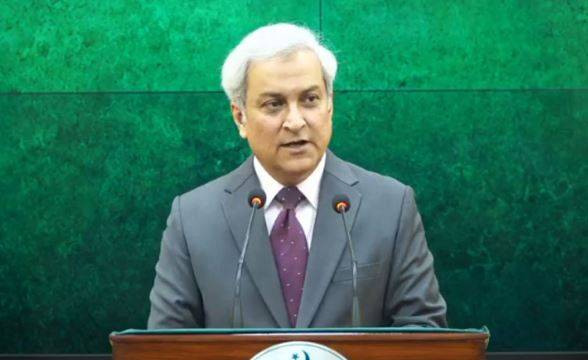
Islamabad (Web Desk): Pakistan on Thursday dismissed Amnesty International’s recent report on its military operations in Afghanistan, arguing that the allegations were unsubstantiated and failed to acknowledge the persistent terrorist threat emanating from Afghan territory.
Speaking during the weekly press briefing, Foreign Office (FO) spokesperson Tahir Andrabi said the report lacked credible evidence and ignored the security challenges Pakistan continues to face.
He maintained that the country’s military actions were conducted strictly within the framework of international law and represented Pakistan’s legitimate right to self-defence.
Andrabi said militant organisations, including the Tehrik-e-Taliban Pakistan (TTP), the Balochistan Liberation Army (BLA), and their allied groups, continue to operate from sanctuaries inside Afghanistan under the Taliban administration, using them as bases to organise and launch attacks across the border.
He noted that thousands of Pakistanis had been killed in acts of terrorism planned from Afghan soil, stressing that Pakistan’s security operations were aimed exclusively at terrorist infrastructure and logistical networks while adhering to internationally recognised principles of distinction, precaution and proportionality.
Calling for greater international attention to the root causes of instability in the region, the spokesperson urged Amnesty International to investigate the Afghan Taliban’s continued tolerance and support of terrorist organisations.
He also called for the Taliban authorities to be held accountable for obligations outlined in United Nations Security Council resolutions and the Doha Agreement.
Turning to developments in the Middle East, Andrabi strongly denounced the latest threats issued by Yemen’s Houthi militia against Saudi Arabia and commercial shipping in the Red Sea.
He warned that any hostile action targeting Pakistani-flagged vessels or the country’s maritime interests would be regarded as a serious threat to national security, adding that Pakistan reserved the right to respond with all necessary measures in self-defence under international law.
Answering a question from reporters, the spokesperson described Pakistan’s sovereignty and security as a “red line,” asserting that any assault on Pakistani interests would be treated as an attack on the country itself and would prompt an appropriate response.
He also reiterated Pakistan’s firm support for Saudi Arabia’s sovereignty, territorial integrity and security, while expressing concern over attempts to further expand the conflict in the Middle East.
Andrabi said Pakistan continued to promote dialogue and diplomacy as the preferred means of reducing regional tensions. In this context, he referred to the recent visit of Iranian Foreign Minister Iskandar Momeni, who held meetings with Prime Minister Shehbaz Sharif, the interior minister and Pakistan’s military leadership.
The spokesperson added that Islamabad remained actively engaged with regional partners.
He said Deputy Prime Minister and Foreign Minister Ishaq Dar met his counterparts from Kuwait, Egypt, Oman and Russia on the sidelines of meetings in Manila, where discussions centred on de-escalation, regional stability, maritime security and bilateral cooperation.
He further said Dar would head Pakistan’s delegation at the upcoming Shanghai Cooperation Organisation Council of Foreign Ministers meeting in Bishkek, where he is scheduled to hold bilateral talks with several participating foreign ministers.
According to Andrabi, Dar also represented Pakistan at the 31st ASEAN Regional Forum Ministerial Meeting in Manila, reaffirming Islamabad’s commitment to regional peace, constructive dialogue and multilateral cooperation.
On Pakistan-Canada relations, the spokesperson described Canadian Foreign Minister Anita Anand’s trip as the first visit by a Canadian foreign minister to Pakistan in two decades. He said the two sides exchanged views on trade, investment, climate cooperation, regional developments and people-to-people contacts.
He added that both countries signed a protocol covering phytosanitary import requirements for genetically modified canola, a move expected to facilitate agricultural trade and deepen bilateral economic ties.
Commenting on the European Commission’s latest GSP Plus monitoring report, Andrabi welcomed its acknowledgement of Pakistan’s legislative progress and continued implementation of the 27 international conventions required under the scheme.
At the same time, he expressed dissatisfaction with what he described as the report’s overall tone, saying it did not accurately reflect Pakistan’s achievements since becoming part of the GSP Plus framework in 2014.
He emphasised that the scheme remained a cornerstone of Pakistan’s economic relationship with the European Union (EU) by boosting exports, creating jobs, promoting women’s economic participation and contributing to poverty reduction, while reaffirming Pakistan’s commitment to meeting its international obligations.
Discussing Afghanistan, Andrabi said Pakistan remained committed to facilitating Afghan nationals through legal channels and had already assisted more than 90,000 Afghans in relocating to third countries.
He reiterated that Afghan citizens must possess valid documentation to remain in Pakistan and said those residing unlawfully were subject to deportation under Pakistani law. However, he emphasised that Pakistan continued to regard ordinary Afghan citizens as brothers and rejected attempts to stigmatise or spread hatred against them despite existing security concerns.
The spokesperson also reaffirmed Pakistan’s unwavering backing for the Palestinian cause, saying the country remained engaged with Islamic nations in efforts to promote peace and continued to support the establishment of an independent Palestinian state in accordance with international law.
Responding to another query, Andrabi said Pakistan would continue drawing international attention to alleged human rights violations in Indian Illegally Occupied Jammu and Kashmir (IIOJK).
He also cited the case of convicted Indian spy Kulbhushan Jadhav, describing it as proof of India’s alleged involvement in activities intended to destabilise Pakistan.
Neo News | Copyright © 2026