Thu, September 17, 2026

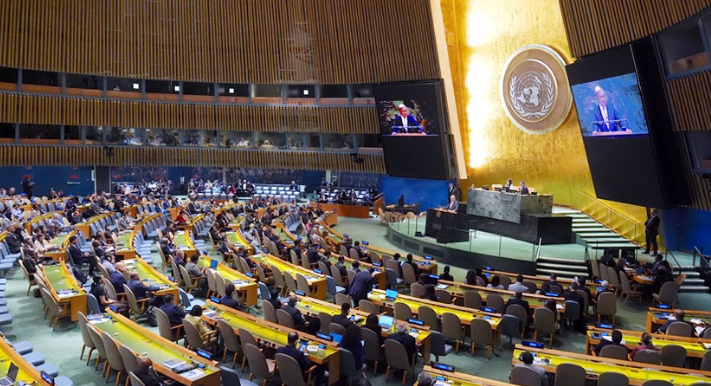
New York (Web Desk): World leaders are gathering in New York this week for the United Nations General Assembly, which is set to be heavily influenced by the wars in Gaza and Ukraine, growing Western recognition of a Palestinian state, and increasing concerns about Iran’s nuclear ambitions.
Pakistan’s Permanent Representative to the UN, Ambassador Asim Iftikhar Ahmad, said the session carries special significance as it coincides with the UN’s 80th anniversary.
He noted that Prime Minister Shehbaz Sharif will lead the country’s delegation and take an active part in discussions on major regional and global issues. UN Secretary-General António Guterres described the moment as one of unprecedented strain on international cooperation, warning that the world is navigating turbulent and uncertain waters.
More than 150 presidents and prime ministers, along with dozens of ministers, are expected to participate in the high-level debate starting September 23, with US President Donald Trump among the first to address the Assembly. Authorities in New York have imposed extensive security arrangements involving thousands of police officers, drones, helicopters, and harbor patrols around UN Headquarters to protect visiting dignitaries.
Prime Minister Shehbaz will deliver his address on September 26, marking his third appearance before the 193-member Assembly.
According to the Foreign Office, his remarks will highlight the humanitarian catastrophe in Gaza, the struggle for self-determination in Jammu and Kashmir, climate change, terrorism, Islamophobia, and sustainable development.
He is expected to push for urgent international action to secure a ceasefire in Gaza and emphasize the importance of addressing long-standing occupations that deny fundamental rights, particularly in Palestine and Indian-administered Kashmir.
This year’s gathering comes in the wake of recent moves by the United Kingdom, Canada, and Australia to recognize the State of Palestine, adding to a growing list of Western nations supporting Palestinian sovereignty amid the ongoing conflict.
The General Assembly last week adopted the “New York Declaration,” which emerged from a conference co-hosted by France and Saudi Arabia and called for a just and lasting peace under international law based on a two-state solution.
Shehbaz Sharif’s participation will extend beyond his main speech, as he is scheduled to attend high-level meetings on climate change, global development, and peace and security. He will also join a select group of Islamic leaders for a meeting with President Trump to exchange views on pressing international challenges. Bilateral meetings with world leaders and senior UN officials are also planned, during which Pakistan will underscore its resolve to work with all member states in upholding the UN Charter, preventing conflict, and promoting peace and prosperity in its capacity as a Security Council member.
The Foreign Office stressed that Pakistan’s engagement will reflect its longstanding commitment to multilateralism and its contributions to collective global goals.
This year’s General Debate will be chaired by Annalena Baerbock of Germany, who becomes only the fifth woman in UN history to preside over the Assembly. The theme of the session is “Better Together: 80 Years and More for Peace, Development, and Human Rights.”
Leaders will also convene on September 22 to discuss the Beijing+30 Action Agenda, focused on advancing gender equality, ensuring climate justice, ending violence against women, and promoting their full participation in decision-making.
As the climate crisis accelerates, a dedicated summit on September 24 will assess progress toward keeping global temperature increases below 1.5 degrees Celsius. Governments will present their updated national climate action commitments and join business and civil society leaders in advancing plans on mitigation, adaptation, financing, and reliable climate information.
The outcomes of the summit will feed into COP30, to be hosted in Brazil later this year.
Another major focus of the week will be Artificial Intelligence, with world leaders gathering on September 25 to deliberate a global framework for governing AI technologies.
With no existing international body overseeing the field, the UN chief has warned that without safeguards, AI could deepen inequalities and undermine human rights.
He urged leaders to seize the moment to ensure AI develops in a way that benefits all of humanity rather than only a privileged few.
Neo News | Copyright © 2026