Thu, September 17, 2026

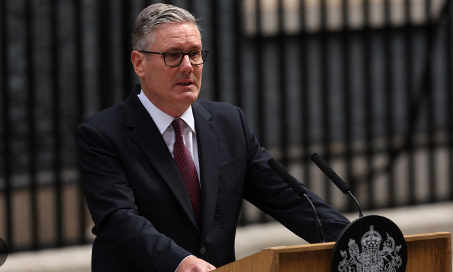
London (Web Desk/Agencies): British Prime Minister Keir Starmer announced on Monday that he would step down after coming under intense pressure from within his own centre-left Labour Party.
Speaking outside 10 Downing Street, Starmer said he respected the party’s decision and would support whoever takes over the leadership.
“Every decision I have taken has been about putting the country I love first, and that is why I will resign as leader of the Labour Party.”
He further disclosed that he had informed King Charles III of his decision earlier that morning.
Starmer said he had requested the Labour Party’s National Executive Committee to establish a leadership election timetable beginning on July 9 and concluding before Parliament’s summer recess.
“In the case of a contest, this will ensure a new leader is in place before parliament returns in September,” he said.
He added that he would continue serving as prime minister until the leadership race is completed.
“I will do everything I can to ensure an orderly handover of power,” he added.
At the beginning of his statement, Starmer described becoming Labour prime minister two years ago as the most significant achievement of his political career.
“A new Labour government in 14 years, a page in our country’s history turned after years of disappointment and despair, the chance to change the lives of millions of people for the better,” he said, explaining that such ambitions had inspired him to enter politics.
Looking back on his time as Labour leader, Starmer said he inherited a party six years ago that was struggling politically, financially and morally.
He recalled how critics repeatedly insisted that Labour’s future was over and that securing a parliamentary majority, let alone a landslide victory, was beyond reach.
“That we were consigned to history and that the majority of the general election, let alone a landslide majority, was not possible,” he said.
Starmer argued that those predictions were ultimately proven wrong as Labour rebuilt itself and returned to government.
“We changed our party, ripping out anti-semitism, restoring trust in the economy, defence, national security and becoming a party that once again stood proudly with, not against, our national flag,” Starmer said.
According to a source familiar with the matter, Starmer spent the weekend weighing his options, deciding whether to defend his position through a leadership challenge or leave office voluntarily, less than two years after leading Labour to a commanding election victory that had promised to bring stability to British politics.
“Keir likes to think about things,” the source said on condition of anonymity.
The pressure on Starmer had been building steadily for months but intensified dramatically on Friday after Greater Manchester Mayor Andy Burnham won a parliamentary election and returned to Westminster. Burnham defeated a candidate from Nigel Farage’s Reform UK party, which has topped national opinion polls for more than a year.
The result encouraged many Labour lawmakers who believe Burnham’s political experience and communication skills could help revive the party’s fortunes after a period in which support for Labour declined under Starmer and the prime minister’s popularity ratings fell sharply.
However, many questions remain about what a Burnham leadership would look like. Beyond calling for major change and measures to reduce living costs, he has yet to outline detailed positions on foreign policy, economic management and defence.
Political observers note that Burnham could face many of the same obstacles that limited Starmer’s room for manoeuvre, including financial markets reluctant to support higher borrowing and voters increasingly frustrated with the country’s direction.
As per the international media reports, Britain currently faces the highest borrowing costs among the G7 nations due to heavy debt burdens, rising interest payments, years of weak economic growth, difficulties in reducing public spending and the need for increased investment in sectors such as defence.
Neo News | Copyright © 2026