Thu, September 17, 2026

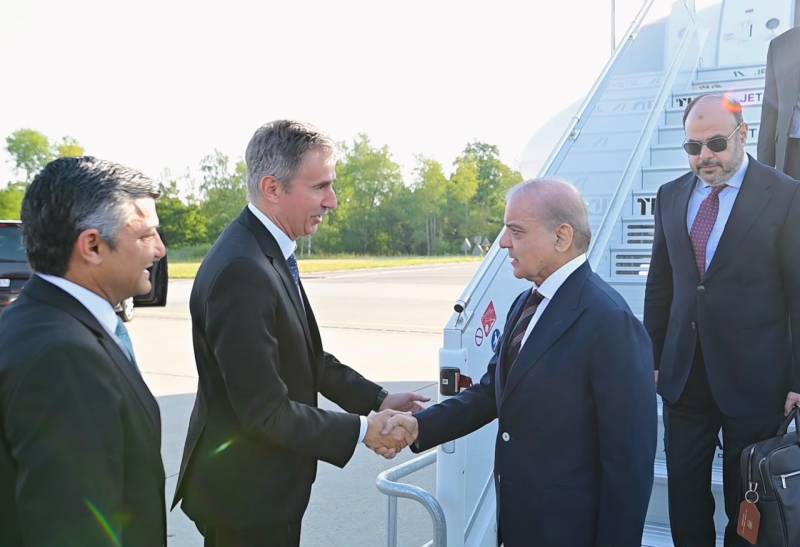
Zurich (Web Desk): Prime Minister Shehbaz Sharif reached Zurich on Sunday alongside a senior delegation to attend crucial discussions regarding the implementation of the Islamabad Memorandum of Understanding (MoU), according to the Prime Minister’s Office (PMO).
Zürich: 21 June 2026.
— Prime Minister's Office (@PakPMO) June 21, 2026
Prime Minister and Field Marshal to participate in the High-Level Talks on the implementation of the Islamabad Memorandum of Understanding being held in Burgenstock, Switzerland, on 21st of June 2026.
Prime Minister Muhammad Shehbaz Sharif has arrived in… pic.twitter.com/PGEL9vIVsl
The PMO stated that PM Shehbaz and Chief of Army Staff (COAS) and Chief of Defence Forces (CDF) Field Marshal Syed Asim Munir, will "participate in the High-Level Talks on the implementation of the Islamabad Memorandum of Understanding.”
During his stay in Bürgenstock, Prime Minister Shehbaz is also scheduled to hold separate meetings with representatives from Iran, the United States (US), Qatar and Switzerland.
Earlier in the day, the Foreign Office (FO) said these engagements are intended “to reaffirm Pakistan's enduring commitment to dialogue and durable peace in the region.”
The talks had originally been planned for Friday, but Switzerland’s foreign ministry later announced that the meeting would not proceed as scheduled and did not provide any explanation for the postponement.
The prime minister and Field Marshal Syed Asim Munir, left for Switzerland on Saturday night to take part in the discussions.
The FO described the gathering as “the first formal engagement after the signing of the Islamabad MoU on June 17, 2026”.
The meeting in Switzerland serves as the first official follow-up since the agreement was signed earlier this week. Senior-level delegations from Iran, Qatar and the United States are participating in the dialogue.
“Pakistan will continue to support and advance the implementation of the understandings reached between the Islamic Republic of Iran and the United States,” the FO statement said.
The FO also highlighted Pakistan’s diplomatic efforts during the crisis, saying they reflected its “principled, balanced, and constructive approach throughout the crisis”, including “hosting earlier rounds of US-Iran talks and sustained diplomatic contacts that culminated in the Islamabad Memorandum of Understanding”.
PR No.1️⃣4️⃣9️⃣/2️⃣0️⃣2️⃣6️⃣
— Ministry of Foreign Affairs - Pakistan (@ForeignOfficePk) June 21, 2026
Curtain Raiser:High-Level Talks on the Implementation of Islamabad Memorandum of Understanding (Bürgenstock, Switzerland-21 June,2026)
⬇️ pic.twitter.com/N7NoLYHXuv
On June 18, PM Shehbaz formally signed the Islamabad MoU in his role as mediator, marking a significant diplomatic achievement between the US and the Islamic Republic of Iran.
Israel, which was not included in the peace negotiations, has remained distant from the US-Iran agreement and has continued military operations against the Iranian-backed Hezbollah movement in Lebanon. The ongoing fighting has raised uncertainty about the durability of the deal.
The 14-point accord extends the ceasefire announced in April by another 60 days, including provisions covering Lebanon, to create room for negotiations on a permanent peace arrangement.
Officials from both Washington and Tehran confirmed that US President Donald Trump and Iranian President Masoud Pezeshkian signed the memorandum electronically in both English and Farsi. Iran’s foreign ministry said the agreement had already come into force on Wednesday.
Trump reportedly signed the document shortly before attending a state dinner with French President Emmanuel Macron at the Palace of Versailles, the historic location where the treaty that formally ended World War One was signed.
Following the signing ceremony, both governments released the full text of the Islamabad MoU, which their presidents endorsed on Wednesday to bring an end to the conflict. However , Trump warned that attacks could resume and Iranian officials could be targeted if Tehran failed to fulfill its obligations under the agreement.
The conflict began on February 28 when the US and Israel launched military operations against Iran, killing 86-year-old Supreme Leader Ayatollah Ali Khamenei and several senior military commanders on the first day.
The confrontation rapidly expanded into a wider regional war that has left more than 7,000 people dead, most of them in Iran and Lebanon. The war has also pushed energy prices higher, intensified inflationary concerns and heightened fears of a serious food supply crisis in developing nations.
Neo News | Copyright © 2026