Thu, September 17, 2026

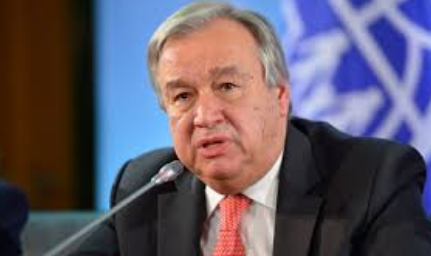
Baghdad (Web Desk): At the League of Arab States Summit held in Baghdad on Saturday, United Nations (UN) Secretary-General António Guterres delivered a broad and urgent appeal to regional leaders, warning of escalating crises across the Middle East and beyond.
Speaking with a sense of immediacy, he highlighted the ongoing conflict in the Gaza Strip as the most pressing challenge, reiterating the necessity of a lasting ceasefire and underscoring the critical importance of resuming the path toward a two-State solution for Israelis and Palestinians.
Addressing the worsening humanitarian toll, Guterres made it clear that the violence that erupted on 7 October 2023 with attacks by Hamas, as well as the harsh retaliatory measures against the entire Palestinian population, are both indefensible.
He called for an immediate halt to hostilities, the unconditional release of captives, and the unrestricted delivery of life-saving aid into Gaza, demanding an end to the blockade.
Expressing deep concern over reported plans by Israel to broaden its military operations, the Secretary-General emphasized that the United Nations would not endorse or participate in any aid mechanisms that circumvent international law or violate the humanitarian principles of neutrality, independence, impartiality, and humanity.
Guterres also defended the vital role of the UN agency for Palestine refugees (UNRWA), calling for unwavering financial support. He rejected all forms of forced relocation, particularly any suggestion of transferring the Gaza population beyond its borders, and warned against overlooking the deteriorating conditions in the occupied West Bank.
He stated unequivocally that the expansion of settlements and any moves toward annexation are violations of international law.
The UN chief said that only a negotiated two-State framework can bring about a durable peace.
He pointed to a forthcoming international meeting in June, to be co-hosted by France and Saudi Arabia, as a critical juncture for restoring momentum toward a diplomatic resolution.
Turning to Lebanon, Guterres urged all actors to respect the country’s sovereignty and borders.
He voiced support for the Lebanese government's efforts to reassert control throughout its territory, praising ongoing security reforms and the increasing presence of Lebanese Armed Forces in the south, supported by the UN peacekeeping mission, UNIFIL.
Regarding the Syrian crisis, he reaffirmed the principles of territorial integrity, national unity, and sovereignty.
He encouraged broader international backing for a political process led and owned by Syrians themselves—one that guarantees representation, protects civil rights, and reflects the country’s diverse population.
In the case of Yemen, the Secretary-General condemned the recent Houthi strikes in the Red Sea, citing their disruptive impact on commerce and economic stability in the region.
He welcomed the truce reached on May 6, brokered by Oman between the Houthis and the United States, as a positive development. He also demanded the immediate release of United Nations personnel and other individuals who remain unlawfully detained in the country.
Shifting focus to Sudan, Guterres emphasized the urgency of coordinated international efforts to confront the surge in violence, worsening famine, and massive displacement.
He expressed appreciation for the collaborative meeting recently organized by the Arab League and the African Union, commending both entities for enhancing diplomatic cooperation in the face of a spiraling humanitarian crisis.
The UN chief also discussed Somalia, highlighting the importance of national unity and dialogue among all stakeholders.
He stressed the need for sustained international financial assistance to bolster the African Union’s stabilization mission, particularly in combatting the ongoing threat posed by Al-Shabaab insurgents and in promoting broader peace and security.
In Libya, he described current UN engagement as focused on de-escalating armed confrontations, safeguarding independent oversight bodies, and eliminating the obstacles preventing long-overdue national elections.
He reiterated that the future of Libya must reflect the will and needs of its people and be guided by a vision for lasting political and economic stability.
Concluding his address, Guterres reflected on Iraq’s progress over the past two decades. He applauded the nation’s efforts in strengthening governance structures, resolving disputes through peaceful means, delivering aid, and advancing both sustainable development and human rights.
He confirmed that the UN Assistance Mission for Iraq (UNAMI) is continuing to support the country and is on track to complete its remaining responsibilities before winding down operations at the end of the year.
Ending on a note of cautious optimism, the UN chief urged leaders to draw strength and inspiration from Baghdad’s example, expressing hope that through unity and international solidarity, the region could move toward a future defined not by conflict, but by cooperation, peace, and shared prosperity.
Neo News | Copyright © 2026