Thu, September 17, 2026

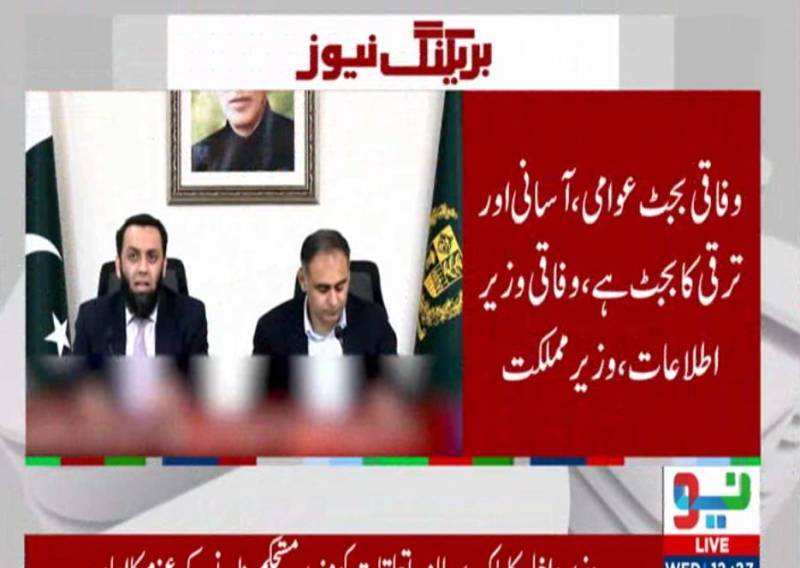
Islamabad (Web Desk): Minister for Information and Broadcasting Attaullah Tarar has said that the government’s latest budget has been framed with a focus on easing public burden, promoting development, and ensuring broader economic stability and prosperity.
He expressed these views during an online briefing on Wednesday on the federal budget for the financial year (FY) 2026-27 held for social media influencers, where Minister of State for Finance Bilal Azhar Kayani also accompanied him.
Tarar remarked that the new budget stands apart from previous fiscal plans, adding that criticism for the sake of criticism has become a habit for some quarters. He also pointed out that even segments of the opposition have acknowledged certain positive elements in the budget.
The minister stated that Prime Minister Shehbaz Sharif played a key role in successfully negotiating and settling issues with the International Monetary Fund (IMF), which, according to him, helped strengthen economic stability.
Tarar further said the prime minister has repeatedly assured over the last two years that relief would be extended to the public whenever financial room was available, while this time the government actively generated that space.
Highlighting reforms, Tarar said significant changes were introduced in the Federal Board of Revenue, including the integration of the tax system, widening of the tax base, and steps to improve transparency and merit.
He stressed that the government’s stance under the prime minister’s direction was that honest taxpayers should not bear the burden of tax evasion by others.
He added that the Pakistan Muslim League-Nawaz (PML-N) leadership had prioritised economic stabilisation, with Prime Minister Shehbaz Sharif personally overseeing economic affairs in line with the vision of Muhammad Nawaz Sharif.
The information minister also noted that had discussions with the International Monetary Fund in Paris not reached a successful conclusion, the country could have been pushed towards default.
Tarar further said that tax leakages were effectively contained in sectors including sugar, cement, tobacco, beverages, and other industries.
He revealed that enforcement measures led to the recovery of around Rs800 billion in tax revenue over the past year, while relief measures were extended to salaried individuals, exporters, and industry in the upcoming budget.
The information minister added that reforms in the sugar sector alone resulted in an additional Rs60 billion in tax collection, while strict action and raids helped curb illegal trade activities. He also mentioned that Rs90 billion had been set aside for the “Apna Ghar” housing initiative under new budgetary plans.
The minister said the prime minister, along with his entire team, worked continuously to ensure economic stability.
He also commended Finance Minister Muhammad Aurangzeb, Field Marshal Syed Asim Munir, their respective teams, and other stakeholders, including the Special Investment Facilitation Council (SIFC), for their contributions toward improving the country’s economic outlook.
Speaking on the occasion, Minister of State for Finance Bilal Azhar Kayani described the upcoming budget as pro-people and relief-focused, saying it is designed to benefit exporters, industrial sectors, housing and construction, youth, women, salaried workers, and taxpayers.
He said special attention had been given to expanding the tax base while easing pressure on vulnerable segments of society. He added that new tribunals had been formed to address tax disputes and support improved revenue collection.
Responding to a question, he clarified that education and health fall under provincial jurisdiction, and therefore federal allocations in these areas should be considered alongside provincial spending.
During the session, both ministers also addressed various queries raised by the participating social media influencers.
Neo News | Copyright © 2026