Thu, September 17, 2026

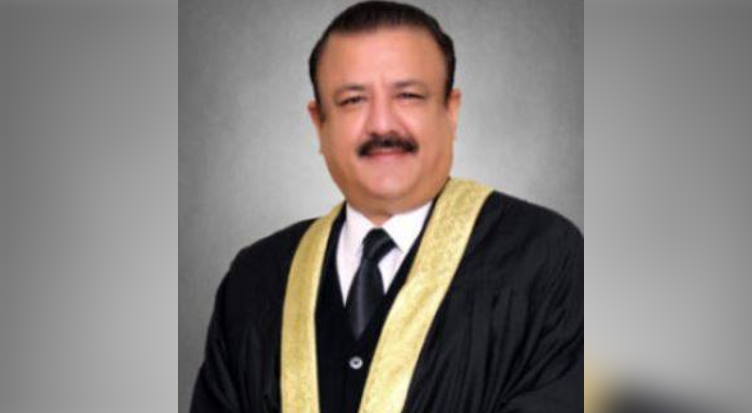
Islamabad (Web Desk): A two-member Islamabad High Court (IHC) bench, led by Chief Justice Sardar Mohammad Sarfraz Dogar and comprising Justice Mohammad Azam Khan, has directed that Justice Tariq Mehmood Jahangiri will not perform judicial functions until the Supreme Judicial Council (SJC) announces its decision regarding allegations of a fake academic qualification.
The controversy traces back to July last year, when a complaint about Justice Jahangiri’s law degree was filed with the SJC, followed by a petition earlier this year in the IHC challenging his appointment.
Central to the matter is a letter that surfaced on social media, attributed to the controller of examinations at the University of Karachi, raising questions about the authenticity of his degree.
During the latest hearing, the bench not only suspended Justice Jahangiri from judicial duties but also appointed Barrister Zafarullah Khan and Ashtar Ausaf as amici curiae.
Assistance from the attorney general was also sought concerning whether the petition is maintainable.
The court noted that the case would remain adjourned until the SJC issues its verdict, observing that an important question arises on whether a matter pending before the Supreme Judicial Council can simultaneously be taken up by a high court.
Raja Aleem Abbasi, representing the Islamabad Bar Association, remarked that adherence to the rule of law was paramount and emphasized that bar associations were stakeholders in such issues.
CJ Dogar observed that every party has the right to a hearing and that objections raised by the registrar’s office must also be examined. Abbasi cautioned that if such petitions become a recurring trend, it could create risks for the system, insisting that the registrar’s objections should be upheld.
After issuing its ruling, the bench confirmed that Justice Jahangiri will not engage in judicial work until the SJC resolves the matter. A revised duty roster was later released by the IHC, in which his name no longer appeared on any bench.
The petition against him, filed under Article 199 of the Constitution, seeks a writ of quo warranto, questioning his authority to hold judicial office on the basis that his LLB degree from Karachi University is invalid, thereby casting doubt on his entire legal career and subsequent elevation to the bench.
The case relies on correspondence from the University of Karachi, highlighting discrepancies such as the allocation of two different enrollment numbers. The enrollment number AIL-5968/87, shown on his LLB Part-I mark sheet, was officially assigned to another student named Imtiaz Ahmad.
Furthermore, the principal of Government Islamia Law College, Karachi, stated that a student by the name of Tariq Mehmood, son of Qazi Muhammad Akram, listed with enrollment number AIL-7124/87, had never been admitted to the institution’s LLB program. The University’s controller of examinations later confirmed in a letter that the degree and mark sheets in question were not valid.
The petitioner has argued that the appointment of a judge without a valid legal qualification goes beyond an administrative lapse and constitutes a violation of citizens’ fundamental rights. It was further submitted that the existence of a judge with an invalid degree undermines public confidence and damages the judiciary’s image as an impartial institution.
Justice Jahangiri is among the group of judges who opposed the transfer of Chief Justice Dogar to the IHC alongside Justices Khadim Hussain Soomro and Mohammad Asif.
He also signed a letter to the SJC last year, alleging interference by intelligence agencies in judicial affairs. Just prior to the controversy over his credentials, he was actively presiding over petitions challenging alleged electoral rigging in all three constituencies of Islamabad.
Neo News | Copyright © 2026