Thu, September 17, 2026

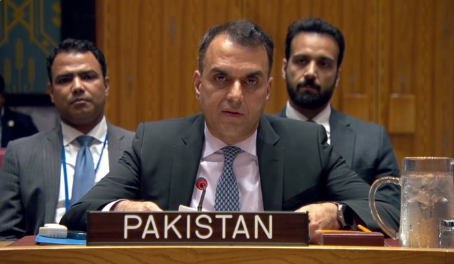
New York (Web Desk): Pakistan has strongly condemned the Houthi ballistic missile attacks against Saudi Arabia, reaffirming its full solidarity with the Kingdom and unwavering support for its security, sovereignty, and territorial integrity.
This was stated during United Nations Emergency Briefing on developments in the Middle East, with a focus on Yemen.
In a post shared on X, Pakistan's Permanent Mission to the United Nations said Ambassador Usman Jadoon denounced the Houthi missile strikes targeting Saudi Arabia.
Statement by Ambassador Usman Jadoon,
— Permanent Mission of Pakistan to the UN (@PakistanUN_NY) July 14, 2026
Deputy Permanent Representative of Pakistan to the UN,
At the UN Security Council Emergency Briefing on the Situation in Middle East (Yemen)
(13 July 2026)
****
We thank ASG Khaled Khiari and acting ASG Indrika Ratwatte for their… pic.twitter.com/AzYbr4Vr01
"We express our full solidarity with the brotherly Kingdom and reaffirm our steadfast support for its security, sovereignty, and territorial integrity," he said.
The ambassador also reaffirmed Pakistan's commitment to Yemen's sovereignty, independence, unity and territorial integrity, stressing that Islamabad's position remains firmly aligned with the principles of the UN Charter and international law.
"We also reaffirm our unwavering commitment to the sovereignty, independence, unity and territorial integrity of Yemen, consistent with the purposes and principles of the UN Charter and international law, he said."
Jadoon urged all parties involved to prioritise peaceful engagement over confrontation.
He called on stakeholders "to resolve differences through dialogue, diplomacy, and a steadfast commitment to de-escalation," particularly during "a time when the region continues to face heightened tensions and multiple interconnected crises".
He emphasised that a lasting solution to Yemen's conflict could only emerge through an inclusive political process led by Yemenis themselves and supported by the United Nations.
"A comprehensive, inclusive and sustainable peace can only be achieved through a Yemeni-led and Yemeni-owned political process, facilitated by the UN, which addresses the legitimate aspirations and concerns of all Yemenis," the Pakistani envoy said.
Referring to the prisoner exchange agreement reached earlier this year, the ambassador said it had shown that negotiations could still produce meaningful progress despite the difficult circumstances.
He cited the agreement as having demonstrated that "dialogue can yield tangible outcomes even in a difficult environment".
Jadoon further encouraged all sides to build on that positive development. "All parties," the ambassador noted, "should build on this momentum and continue engaging constructively towards a durable nationwide ceasefire and an inclusive political settlement".
Highlighting the humanitarian situation in Yemen, he said the country's people had suffered through years of war, displacement, economic decline, food shortages and the collapse of essential public services. "Any further escalation risks undermining prospects for peace and deepening the suffering of civilians," Jadoon stated.
Pakistan also condemned the continued detention of UN officials, humanitarian workers and diplomatic staff by the Houthis, along with the seizure of UN facilities and assets. Jadoon described these actions as violations of international law that were obstructing humanitarian operations.
"These actions contravene international law and undermine humanitarian work," the ambassador said, adding that Islamabad calls for "the immediate and unconditional release of all detained personnel and for full respect for the privileges and immunities of UN personnel, facilities and assets".
Reaffirming Pakistan's commitment to diplomacy and regional peace, Jadoon said Islamabad would continue to support efforts aimed at reducing tensions and promoting dialogue.
He urged all concerned parties to maintain open communication, refrain from actions that could further inflame the situation and seek peaceful solutions in line with the UN Charter and international law.
"Pakistan will continue to support all sincere efforts aimed at fostering peace, stability and mutual understanding in the region," the ambassador concluded.
His remarks came as Yemen's Houthi movement, which controls the country's northern region, accused Saudi Arabia on Monday of carrying out airstrikes on Sanaa International Airport. The group vowed to retaliate, putting the fragile truce between Riyadh and the Iran-backed movement under renewed strain.
Houthi military spokesperson Yahya Saree described the strikes as "blatant aggression" and claimed they had brought an end to the period of de-escalation. He warned that Saudi Arabia would face the consequences and insisted the attack would not remain unanswered.
Saudi authorities, meanwhile, announced that ballistic missiles fired by the Houthis towards the Kingdom's southern region had been successfully intercepted.
Separately, Yemen's internationally recognised government, which is backed by Saudi Arabia, initially ordered the closure of all airports across the country before later confirming that operations had resumed. The defence ministry said the runway at Sanaa International
Airport had been targeted to stop an Iranian aircraft from landing, while a military spokesperson later stated that the plane had instead landed at Houthi-controlled Hodeidah Airport.
Another government minister also alleged that the Houthis were continuing to hold an aircraft belonging to the International Committee of the Red Cross at Sanaa Airport.
Neo News | Copyright © 2026