Thu, September 17, 2026

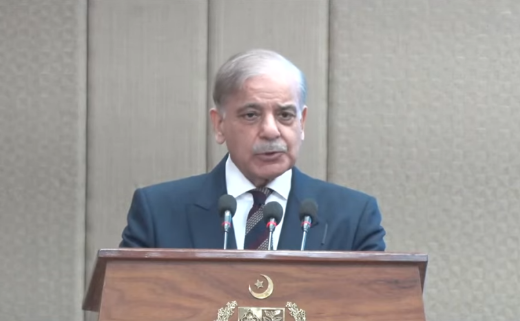
Islamabad (Web Desk): Prime Minister Shehbaz Sharif on Saturday expressed confidence that Pakistan’s economy was gradually recovering, crediting the persistent efforts of the incumbent government and the economic team for the improvement in key indicators.
He recalled that when his government assumed office, the country was facing an extremely challenging economic situation.
“We were on the brink of default. Inflation was skyrocketing, interest rates were suffocating, investments were nearly impossible, and business activities were in disarray. Yet, we did not lose hope,” he said while speaking at the live-televised launch of the National Regulatory Reforms.
PM Shehbaz acknowledged that the challenges had been intimidating but stressed that through teamwork, careful planning, and relentless dedication, Pakistan had managed to navigate through its economic difficulties.
He emphasized that realizing national goals required hard work, commitment, and personal sacrifices.
“Over the past one and a half years, we remained determined to walk a difficult path. And today, Alhamdulillah, we are discussing strategies to move forward and strengthen our economy,” the premier added.
PM Shehbaz also welcomed news of the International Monetary Fund approving a $1.2 billion tranche for Pakistan.
He highlighted that, historically, cumbersome rules and lengthy procedures had hampered industrialists, entrepreneurs, and ordinary citizens, dealing a serious blow to the overall business climate.
Looking ahead, the prime minister said the government was focused on attracting foreign investment in promising sectors such as agriculture, IT, and mining, aiming for mutually beneficial partnerships.
PM Shehbaz also highlighted Pakistan’s young population as a valuable asset and stressed that vocational training programs with international certification would help youth secure productive jobs both domestically and abroad, contributing to the nation’s growth and prosperity.
Calling the launch of the regulatory framework a “quantum leap,” he explained that it would simplify operations for businesses, industry, and agriculture while facilitating foreign investment from Europe, the Far East, and the Middle East.
The premier that the reforms would minimise wasted time and resources, which had previously fostered corruption and nepotism.
“This is an important moment for the nation,” the prime minister said, assuring Pakistan’s 240 million citizens that the government understood the challenges and was committed to moving forward at the pace the people expected.
PM Shehbaz praised federal teams for working in coordination with provincial governments and thanked the British government and International Development UK for their support, describing the UK as a strong partner in Pakistan’s progress, alongside other allies in the Middle East, including Saudi Arabia.
He also highlighted Pakistan’s positive relationship with the United States and expressed hope for enhanced cooperation in the future.
Speaking at the event, Prime Minister’s Special Assistant Haroon Akhtar said the day represented more than a policy announcement; it marked a turning point. He said the most significant reform was the shift from a regulatory state to a developmental state.
Regulatory reforms, he explained, were part of a broader transformation focused on three pillars: tariff rationalization, regulatory modernization, and export-led industrial revival.
Under the new national tariff policy, the government aimed to promote predictability, enhance competitiveness, and gradually eliminate arbitrary duties.
UK Minister of State for International Development, the Right Honourable Baroness Jenny Chapman, highlighted Pakistan’s entrepreneurial potential, abundant resources, and strategic position in global trade.
She described the reforms as a positive achievement reflecting the shared ambitions of the UK and Pakistan. She also noted that strong people-to-people ties supported trade and investment between the two countries.
“Trade currently stands at 5.5 billion pounds annually. We have launched a new trade dialogue and are supporting Pakistan’s efforts to engage its 1.6 million-strong diaspora in the UK to unlock private investment,” she said.
Neo News | Copyright © 2026