Thu, September 17, 2026

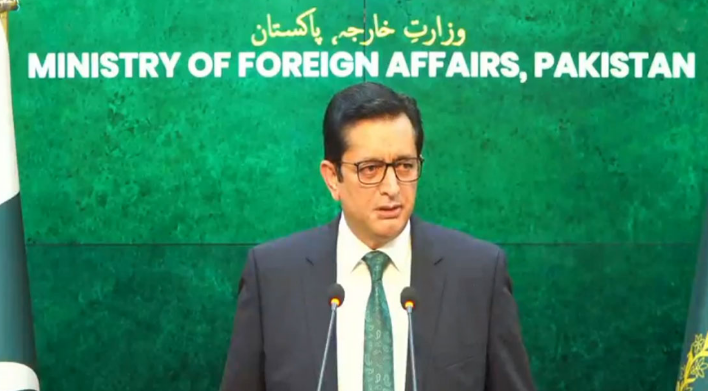
Islamabad (Web Desk): Pakistan on Thursday described the Makkah Joint Defence Agreement as a “defensive alliance” and clarified that there was currently no proposal to expand the pact, explaining that the participating countries first needed to strengthen and consolidate their own framework.
“This is a defensive alliance of the countries which feel that the security of the region has to be protected through deterrence basically… As of now, expansion of the Makkah Agreement is not on the cards because first they have to solidify their own organisation. And then, of course, it will be open for all countries who hold similar views and perceptions and requirements,” Foreign Office spokesperson Sajjad Haider Khan said during his first weekly media briefing in Islamabad today.
He noted that the countries that signed the Makkah pact, including Pakistan, Turkey and Saudi Arabia, remained engaged through regular meetings and consultations at various levels. Any decision regarding the inclusion of additional countries, he said, would ultimately be taken by the three existing members.
“So at this stage, it is not being discussed,” he remarked, adding that the agreement was primarily aimed at promoting regional peace and stability while also reinforcing existing long-standing relations and defence cooperation among the participating countries.
Responding to a question concerning the return of Afghan students from Pakistan, Khan clarified that the government had not issued any blanket directive for the deportation of Afghan students. Those studying in recognised degree programmes and possessing valid visas, he said, were allowed to remain in the country and finish their education.
On CASA-1000 and other important regional connectivity initiatives, the FO spokesperson said the major obstacle remained Afghanistan’s responsibility to address Pakistan’s security concerns related to cross-border terrorism.
He said that once the threat posed by terrorist activities was brought under control, bilateral ties and economic cooperation could return to normal, creating conditions for major energy and transit projects to progress.
Turning to the demolition of mosques in India, Khan said Pakistan was deeply alarmed by what it described as the systematic and state-backed destruction of Islamic religious sites.
He maintained that such actions were a violation of the 1950 Liaquat-Nehru Pact and also contradicted Indian legislation, particularly the Places of Worship Act, 1991, which requires the religious character of places of worship to be preserved.
He said the Hindutva-driven campaign against Muslims had created an increasingly serious threat, leading to the destruction of historic religious and cultural sites that had existed for centuries. He also recalled the demolition of the historic Babri Mosque in 1992 as a painful example of religious intolerance, discrimination and hatred associated with the ideology.
The FO spokesperson urged the international community to take immediate notice of what he called the systematic persecution of Muslims in India and the ongoing destruction and desecration of their places of worship.
Speaking about the affidavit submitted by Hurriyat leader Yasin Malik in relation to charges dating back to 1990, Khan said Malik’s position went far beyond what could simply be described as an act of courage. He termed it a serious indictment of India’s judicial system and said it had exposed what he described as an attempt by the Indian government to use judicial proceedings as part of a campaign against Kashmiri leadership.
Khan reaffirmed Pakistan’s commitment to highlighting Malik’s case and the broader human rights situation in Indian Illegally Occupied Jammu and Kashmir (IIOJK) at every relevant international forum.
He stressed that the Kashmiri people’s right to self-determination, recognised through UN Security Council resolutions, could not be erased through Indian state repression.
Responding to a question regarding the 25th anniversary of the 9/11 attacks, he said the incident had fundamentally transformed the nature of international cooperation. Pakistan, he added, had subsequently made a major contribution to global counter-terrorism efforts, losing more than 80,000 lives and sustaining economic losses estimated at around $150 billion, while continuing to confront terrorism.
“These are largely instigated by India… While India continues to raise the bogey of terrorism against Pakistan and claims that terrorism originates from here, the factual situation on the ground is that India is heavily involved in terrorist activities across nearly all parts of Pakistan, particularly in Khyber Pakhtunkhwa and Balochistan through its state networks. A living example is Kulbhushan Jadhav, who has been in our custody since 2016,” he remarked.
The spokesperson said state-sponsored terrorism required serious attention not only within the region but across the world, including Europe, Canada and the United States, where, he claimed, India’s involvement in targeted activities had been documented.
Describing Kashmir as a dispute recognised at the international level, Khan pointed to maps available on the United Nations website as evidence of its disputed status.
He said that India was trying to portray it falsely and illegally as part of India, which was unacceptable not only to Pakistan but also to the international community, as there were more than a dozen UN Security Council resolutions still pending clearly stating that the final disposition has to be decided by the people through a plebiscite under the auspices of the UN.
Asked about the reported increase in troop deployment in IIOJK, Khan said the scale of security presence was extremely high, with one policeman or military personnel monitoring every seven people.
He said the central purpose of such a deployment was to suppress Kashmiris and prevent them from continuing their demand for the right to self-determination.
Addressing the Houthi attacks against Saudi Arabia, the spokesperson said Pakistan strongly condemned the attacks on civilian and economic targets in Abha, Khamis Mushait, Jazan and Najran.
He said Pakistan wanted to see peace and stability restored in Yemen and continued to support international initiatives aimed at achieving that objective.
Khan also reiterated Pakistan’s firm commitment to the sovereignty, territorial integrity, security and prosperity of Saudi Arabia, stressing that the Kingdom continued to pursue dialogue and diplomatic engagement to promote peace and stability throughout the wider region.
On the issue of repatriating illegal foreign nationals, he said a significant number of people had returned to their countries since the government introduced the relevant policy. However, he added that more than one million individuals were still living in different parts of Pakistan.
He repeated Pakistan’s desire for a peaceful and stable Afghanistan but stressed that the Afghan authorities needed to respond to Islamabad’s serious security concerns by taking action against terrorist groups operating from Afghan territory and involved in attacks inside Pakistan.
The spokesperson also informed journalists that India had recently released 25 Pakistani prisoners. In return, Pakistan had also freed Indian prisoners, with more than 400 Indian nationals released over the past two years after completing their sentences.
Clarifying speculation surrounding the UAE’s visa policy for Pakistanis, Khan said the number of visas granted to Pakistani citizens each year remained considerably higher than the number of Pakistanis repatriated from the country.
He explained that roughly 7,000 to 8,000 Pakistanis were sent back from the UAE each year because of visa overstays, employment-related problems or minor violations. In comparison, around 40,000 to 50,000 Pakistanis obtained employment visas for the UAE annually, making the issuance rate approximately seven to eight times higher than the repatriation rate.
Reviewing Pakistan’s diplomatic engagements over the previous week, Khan highlighted Prime Minister Shehbaz Sharif’s official trip to Kyrgyzstan, during which the two countries concluded 17 agreements and memorandums of understanding aimed at expanding cooperation in areas including defence, trade, energy, CASA-1000 and regional connectivity.
He further said that Deputy Prime Minister and Foreign Minister Senator Ishaq Dar held discussions with his counterparts from Saudi Arabia, Turkiye, Egypt, Kuwait and Norway. He also engaged with the Secretary-General of the Organisation of Islamic Cooperation and UN Secretary-General candidate Olara Otunnu.
Khan dismissed what he called false and politically driven claims by India’s Ministry of External Affairs concerning the Hindu temple at Adda Siraj in Narowal. He said the temple had suffered damage on July 21, 2026, as a result of torrential rainfall, after which local authorities inspected the site and began taking steps for its restoration.
The spokesperson also announced that Pakistan would host the 14th South Asian Games from April 4 to 11, 2027. Events during the eight-day regional sporting competition will be organised in Islamabad, Punjab and Khyber Pakhtunkhwa.
He said the games would include 28 sports and were expected to bring more than 6,000 athletes and officials from different South Asian countries to Pakistan.
Neo News | Copyright © 2026