Thu, September 17, 2026

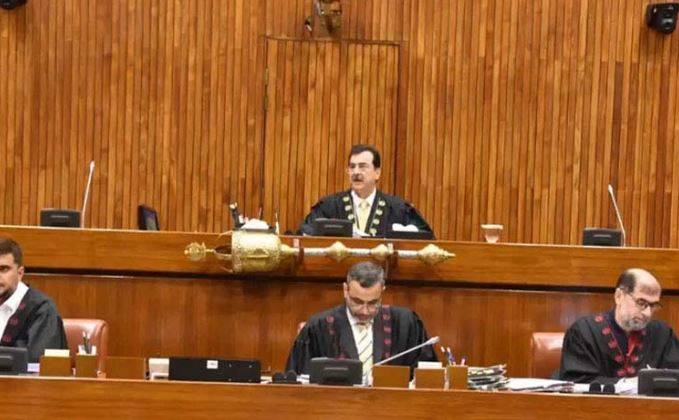
Islamabad (Web Desk): Senate Chairman Yousaf Raza Gillani directed that the proposed 27th Constitutional Amendment bill be sent to the Standing Committee on Law and Justice for further review.
Earlier, the bill was presented to the Senate with Law Minister Azam Nazeer Tarar requesting the suspension of the question hour and other proceedings so he could brief lawmakers on the contents of the bill.
After the bill’s introduction, Chairman Gillani referred it to the Law and Justice Committee for a thorough examination. He also instructed the committee to invite the chairperson and members of the National Assembly’s Law and Justice Committee to join the deliberations, highlighting the importance of such constitutional changes and the need for cooperation across both chambers of Parliament. Both committees may hold joint sessions and present a comprehensive report to the House.
During the session, PTI Senator Ali Zafar raised an objection, arguing that it was inappropriate to discuss the constitutional amendment while the position of opposition leader was still vacant. He accused the government of rushing the bill through without sufficient consultation, noting that the opposition only received the draft that day and had not had enough time to review it. "We cannot debate something we haven’t even read," he said.
In response, Law Minister Tarar explained that the bill consists of 49 clauses covering five main areas — three primary and two subsidiary. One of the key aspects of the bill is the creation of a "Federal Constitutional Court" as envisioned in the 2006 Charter of Democracy. This court would consist of senior judges from all provinces to handle constitutional matters, while regular courts would continue to manage other cases.
Tarar added that while discussions on the 26th Amendment had considered the idea of creating "constitutional benches" as a trial experiment, these benches ended up consuming a significant amount of court time without hearing a substantial number of cases. Critics had even referred to them as "a court within a court." Based on these discussions, a decision was made to formally establish the Federal Constitutional Court through Parliament, and this provision is now part of the proposed bill.
Another significant aspect of the bill concerns the transfer of high court judges. Under the 1973 Constitution, the president, on the advice of the prime minister, could transfer judges for up to two years without their consent. This provision was repealed by the 18th Amendment, which required judges' consent for transfers. The 26th Amendment had kept this provision but faced criticism for allowing executive interference. The new bill proposes transferring the authority to the Judicial Commission of Pakistan (JCP) while adding safeguards to prevent the transfer of any judge senior to the chief justice.
The bill also addresses delays in Senate elections, particularly in Khyber Pakhtunkhwa, where elections have been postponed for over a year. A new clause has been proposed to resolve disputes over the election of Senate leaders.
Furthermore, the amendment seeks to increase the size of provincial cabinets from 11% to 13% of the total assembly seats and raise the number of provincial advisers from five to seven in response to concerns from provinces outside Punjab.
On the issue of Article 243, which vests control of the armed forces in the federal government, new provisions are being introduced. Tarar clarified that Army Chief General Asim Munir has been awarded the honorary title of Field Marshal, which is symbolic and does not carry additional rank or responsibilities. He explained that this title, like other honorary military titles such as Marshal of the Air Force or Admiral of the Fleet, is a lifelong honor that can only be revoked by Parliament, not by the prime minister.
Additionally, the bill proposes the abolition of the position of Chairman Joint Chiefs of Staff Committee (CJCSC) once the current officeholder completes his term. The role of CJCSC would be absorbed into the position of "Chief of Defence Forces," held by the Army Chief.
Once the bill was presented, Tarar urged both Senate and National Assembly members to join a joint committee to discuss it further. Later in the day, a session was called for a joint meeting between the Law Committees of both houses of Parliament to deliberate on the proposed changes.
Senator Allama Raja Nasir Abbas of Majlis Wahdat-e-Muslimeen (MWM) expressed concern that the bill was being pushed through without broad political consensus. He emphasized that constitutional amendments should be made with the agreement of all stakeholders, not in secrecy. He criticized the government for rushing the bill and warned that the amendments could make the Constitution controversial.
"The Constitution was framed through consensus; why should changes to it not be made in the same way?" he asked, calling the government's approach an "attack on the Constitution."
Deputy Prime Minister Ishaq Dar assured the Senate that there would be a more detailed debate on the bill within the committee, and emphasized that opposition members would be invited to participate in the discussions.
Neo News | Copyright © 2026