Thu, September 17, 2026

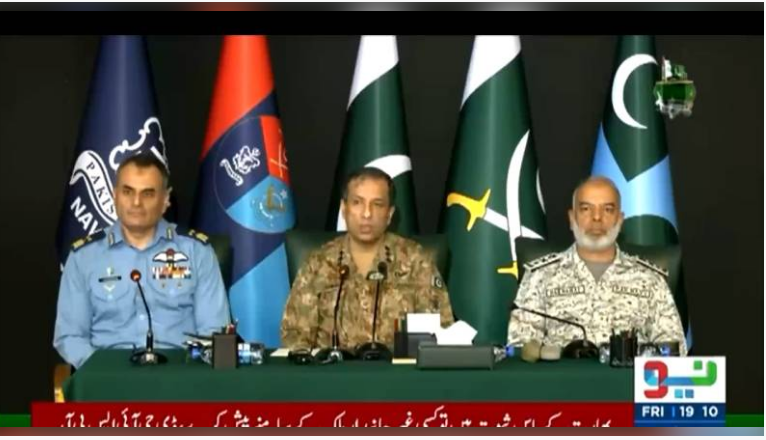
Islamabad (Web Desk): Inter-Services Public Relations (ISPR) Director-General (DG) Lt Gen Ahmed Sharif Chaudhry, while strongly rejecting Narendra Modi government's accusations regarding the Pahalgam attack, said that India is externalising its internal problems by blaming Pakistan.
Briefing the international media alongside Pakistan Air Force (PAF) Director General Public Relations (DGPR) Air Vice Marshal Aurangzeb Ahmed, and Deputy Chief of Naval Staff (Operations) Rear Admiral Raja Rab Nawaz, he warned that New Delhi’s actions risk destabilising regional peace. The senior military officials highlighted the evolving situation at the Line of Control (LoC) and the broader regional implications.
The DG ISPR pointed out the unusual speed—within just ten minutes—with which Indian authorities claimed to have identified the perpetrators.
He said that New Delhi habitually shifts accountability for its own governance and security shortcomings by portraying Pakistan as the antagonist.
Lt Gen Chaudhry reiterated Pakistan’s position on Kashmir, describing it as a disputed territory acknowledged by the international community.
He slammed India for trying to redefine the conflict as a domestic matter, thereby sidestepping diplomatic and humanitarian responsibilities.
The DG ISPR asserted that India has a pattern of using civilian casualties to serve political narratives.
He said that following the recent Pahalgam incident, India hastily pointed fingers at Pakistan without waiting for any investigation or evidence to emerge.
The military's spokesperson also showcased video evidence featuring voices from within India—citizens, Kashmiris, retired military personnel, and political leaders—who attributed the Pahalgam incident to a lapse in India’s own security apparatus.
These perspectives, the DG ISPR said, were intentionally suppressed in Indian mainstream media, which he accused of constructing false narratives against Pakistan.
Criticize India’s digital clampdown, Lt Gen Chaudhry said that it has systematically curtailed free speech by suspending thousands of social media accounts and restricting platforms accessible in Pakistan.
He said that these actions are part of a strategy to control public perception within India by limiting access to alternative information.
“India is waging a covert campaign to destabilize Pakistan, particularly in Balochistan, through its support of terrorist networks,” the DG ISPR said, adding that the Indian intelligence services have been implicated in extraterritorial assassinations, citing incidents in countries like Canada.
“There are people in India who fund, train, and supply weapons to terrorists operating in Pakistan,” he added.
The DG ISPR said that several terrorists captured in Pakistan confessed to receiving funding, training, and support from Indian intelligence agencies.
He added that an audio tape revealed Indian officers admitting they had been operating a terror network in Lahore and Balochistan for years.
Lt Gen Chaudhry said that terrorist camps were running in India, adding that they were confessing that they were sponsoring terrorists in Balochistan. “India is involved in terrorism not only in Pakistan but also in Canada,” he added.
He said that New Delhi was supporting different terrorist groups in Pakistan, including “Fitna al Khawarij.” “The time has come to question the Indian government,” he added.
The DG ISPR further said that one of the objectives of the Pahalgam attack and the subsequent Indian actions is to divert Pakistan’s armed forces and security agencies’ attention from anti-terror operations in the country.
“Government of Pakistan, its armed forces and security forces are on a daily basis, tightening the noose around India-sponsored terrorism. One of the objectives is to distract and divert the security agencies and armed forces from these counter-terrorist operations.”
He shared a video interview of a man from Balochistan who admitted to receiving support from India. Another clip featured a spokesperson of the banned Baloch Liberation Army (BLA) giving a live interview to Indian media during an attack on the Jaffer Express. “Indian media aired this interview and glorified the act of a terrorist group,” he said.
DG ISPR questioned why Indian media was the first to broadcast the video of the Jaffer Express bombing, asking, “Where did the video come from, and who aired it first? It was India.”
He explained that the attack happened around 1pm, and the footage was broadcast almost immediately, proving a link between the terrorists and Indian media.
While briefing on the Pahalgam incident, he said India accused Pakistan of involvement without presenting any solid proof.
Providing details of the way the Indian media blamed Pakistan shortly after the Pahalgam attack on April 22 without any evidence, the DG ISPR maintained that India had adopted a similar stance in the past as well. “Is this the first time India is doing this? There is a history to it,” he said.
“How did the Indian government jump to the conclusion regarding who the attackers were within 10 minutes of the incident? When you don’t have any evidence, what do you do? You open up the military front.”
He went on to say that India was shifting the blame for the attack on Pakistan to divert attention from its internal problems. He said that India launched attacks on Pakistan and targeting civilians, including women and children.
“The attack ended at 2:20 pm, and by 2:30pm, the FIR was already filed. That means within 10 minutes, police investigated and concluded Pakistan was involved. This is not humanly possible,” he said.
He added that Indian social media accounts started blaming Pakistan by 3:00pm, even though no evidence had been presented. “Where is the proof? Where did they get it so fast?” he asked.
The DG ISPR said that India has “no evidence” for its allegations of Pakistan’s involvement in the Pahalgam attack.
“You just concoct stories. I think the time has come to ask the real and bitter questions that Indian government needs to stop living in cinema and theatrics.”
He said Indian forces had carried out attacks across the Line of Control (LoC), especially targeting residential areas and mosques at night. “This reflects the extremist mindset of the Modi-led government,” he added.
He also played videos of Indian citizens and politicians questioning their government’s narrative and security failures in Indian Illegally Occupied Jammu and Kashmir (IIOJK). Even their own people are raising questions, but the government has no answers, he added.
DG ISPR said India has a history of blaming Pakistan for attacks to serve political purposes. “They use terror incidents for domestic political gains and then kill innocent Kashmiris and Muslims, labelling them as terrorists.”
He also played an interview of a former Indian governor of IIOJK, who blamed the Indian government for orchestrating the Pulwama incident.
“India must stop blaming Pakistan without proof,” the DG ISPR said. “If there is any real evidence, bring it before an independent, neutral commission for investigation. No country has the right to be the judge, jury, and executioner.”
He also revealed that two days after the Pahalgam incident, Indian media falsely reported that two Pakistani terrorists were killed during an infiltration attempt. “They were over 50-year-old civilians from a divided village in Azad Kashmir. Fake weapons were planted to present them as terrorists.”
“These kinds of fake encounters happen regularly. India murders innocent people and labels them as terrorists while the world watches,” he added.
Lt Gen Chaudhry said India banned thousands of social media accounts, including those based in Pakistan, to control the narrative and prevent people from hearing the truth.
The DG ISPR has said that the military has neutralised 77 Israeli drones sent by India so far. “We are taking each one of them out. Not one of them has been able to go back to India, and not one of them will be able to go back.”
He emphasized that Pakistan remains a critical frontline state in the global fight against terrorism—not just defending its own citizens, but also upholding regional and global security.
“India intends to disrupt Pakistan's counterterrorism efforts, which could lead to regional destabilization,” the DG ISPR said.
Neo News | Copyright © 2026