Thu, September 17, 2026

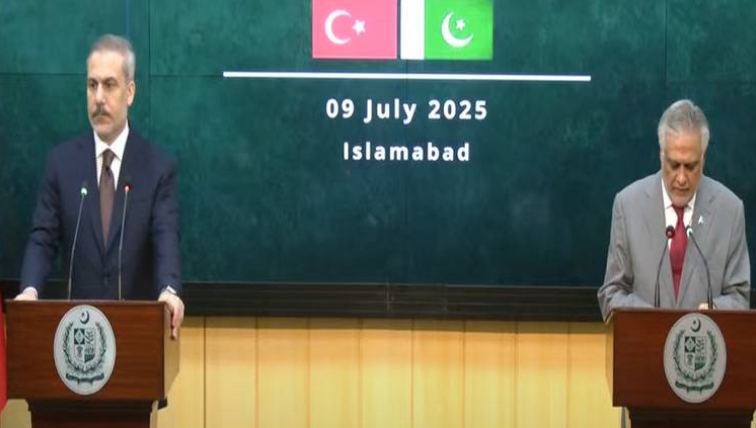
Islamabad (Web Desk): Pakistan and Turkiye have reiterated their commitment to strengthening bilateral cooperation in a wide range of areas, including defence, trade, energy, education, culture, and infrastructure.
In a joint press briefing held in Islamabad, Turkish Foreign Minister Hakan Fidan and Pakistan’s Deputy Prime Minister and Foreign Minister Ishaq Dar underscored their intention to boost the volume of trade between the two nations to $5 billion.
The two leaders expressed satisfaction with the progress made by the 12 Joint Standing Committees operating under the framework of the High-Level Strategic Cooperation Council (HLSCC).
Ishaq Dar recalled that during the last HLSCC session, held in Islamabad in February this year, both countries had agreed to set up a Joint Commission to be co-led by their respective foreign ministers.
This commission was tasked with overseeing and reviewing the performance and developments of the committees, all of which have either convened or are scheduled to do so shortly.
Dar also shared that preparations were underway for the forthcoming meeting of the Joint Ministerial Commission (JMC), which is to be co-chaired by Turkish Minister of National Defence Yasar Güler and Pakistan’s Minister of Commerce Jam Kamal Khan. This upcoming engagement is expected to play a key role in advancing economic collaboration between the two countries.
Highlighting Turkiye’s strides in defence manufacturing, where local production has reached 80 percent from a previous 20 percent, Dar acknowledged Pakistan’s interest in learning from its experience.
He mentioned Pakistan’s ongoing efforts to establish a Special Economic Zone in Karachi specifically for Turkish businesses and noted that discussions were advancing to revive the Istanbul-Tehran-Islamabad rail corridor. Delegations from both sides are expected to meet soon to finalize a roadmap for this project.
Dar further announced that a plot had been allocated in Muzaffarabad for the construction of a Maarif school, demonstrating the growing cooperation in education.
He also noted that Turkish firms were being considered for major ventures, such as the development of the Jinnah Medical Complex, Danish University, offshore exploration projects, and the privatization of power distribution entities. Pakistan is also looking to leverage Turkiye’s expertise in areas such as ship-breaking and water resource management.
On the security front, both nations are exploring avenues for enhancing capabilities in counter-terrorism, which will form part of the groundwork leading up to the next HLSCC session, scheduled to take place in Turkiye in 2026.
Expressing solidarity and goodwill, Dar referred to Turkiye as a reliable and trusted friend, reaffirming the strong ties between the two countries.
In his remarks, Turkish Foreign Minister Hakan Fidan described his meeting with Dar as productive and emphasized that relations between Pakistan and Türkiye were growing stronger each day.
He confirmed both countries' shared ambition to elevate bilateral economic engagement to $5 billion, with expanded cooperation in sectors such as energy, mining, transportation, and education.
Neo News | Copyright © 2026