Thu, September 17, 2026

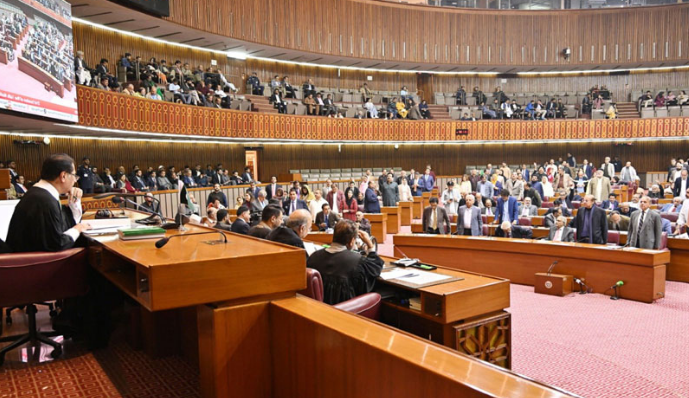
Islamabad (Web Desk): The National Assembly on Wednesday approved the 27th Constitutional Amendment Bill with a two-thirds majority, marking a significant milestone in Pakistan’s ongoing efforts to restructure its judicial and military systems.
The move came two days after the Senate endorsed the key legislation that introduces broad constitutional reforms.
The government incorporated eight new amendments into the bill, replacing four earlier clauses and adding four fresh provisions. One of the key updates includes the insertion of the term Federal Constitutional Court in Clause 2 of Article 6, while Article 10 has been revised to include the word Supreme Court. Another modification in Article 176 specifies that the sitting Chief Justice will continue to be addressed as the Chief Justice of Pakistan until the completion of their tenure.
Following its approval by the lower house, the bill will now return to the Senate to review the new amendments before final ratification. Prime Minister Shehbaz Sharif and PML-N leader Nawaz Sharif were both present during the historic session.
Law Minister Azam Nazeer Tarar, who tabled the bill after a two-day debate, noted that the essence of the proposed reforms had already been presented in the Senate. He described constitutional amendments as part of an evolutionary process and confirmed that all stakeholders had been engaged in drafting the legislation.
Tarar clarified that Justice Yahya Afridi would continue as the Chief Justice of Pakistan and emphasized that the authority to amend the Constitution rests solely with Parliament, not with the judiciary.
The bill, requiring two-thirds support from the 336-member National Assembly, passed comfortably as the ruling alliance held sufficient numbers. The PML-N commands 125 seats, followed by the PPP with 74, MQM-P with 22, PML-Q and the Istehkam-e-Pakistan Party with four each, and one seat each belonging to the PML-Z, BAP, and National Peoples Party.
The 59-clause legislation seeks an extensive reorganization of the judicial and military structures. In the Senate, the amendment passed with 64 votes in favor out of 96, facing no opposition since lawmakers from rival parties boycotted the sitting and tore up copies of the bill in protest. Notably, ANP senators, PTI-backed Saifullah Abro, and JUI-F’s Ahmed Khan supported the bill, while Abro later resigned from the Senate.
During the assembly session, Speaker Sardar Ayaz Sadiq invited Pakhtunkhwa Milli Awami Party chief Mahmood Khan Achakzai to speak on the matter. Achakzai denounced the government, labeling it a “Form-47 setup,” and questioned whether such a parliament, formed through contested elections, held the moral right to amend the Constitution. In a dramatic gesture, he tore his copy of the bill in the House.
Amid the heated exchanges, Speaker Ayaz Sadiq once again urged both the government and opposition to engage in dialogue, offering to act as a mediator.
“As Speaker, I am willing to bring both sides to the table. Dialogue is the only way forward,” he said, adding that Prime Minister Shehbaz Sharif had repeatedly extended invitations to the opposition for talks. PTI Chairman Barrister Gohar Ali Khan responded that his party had “never abandoned dialogue” and remained open to discussion.
Speaking to reporters after the vote, Law Minister Tarar reiterated that if further adjustments were required, the Senate could make them during the next review. “Any ambiguity should be discussed transparently,” he remarked.
Information Minister Attaullah Tarar, addressing the media, lashed out at the opposition for rejecting the bill, accusing them of “double standards” and “selective morality.” He said opposition lawmakers appeared to have “forgotten everything before 2022,” the year Imran Khan was ousted from office.
“When they were in power, they embraced authoritarianism, but now they resist legitimate parliamentary processes,” he said, questioning their credibility.
The 27th Amendment outlines several structural reforms.
It elevates the Chief of Army Staff to the position of Chief of Defence Forces, while honorary titles such as Field Marshal, Marshal of the Air Force, and Admiral of the Fleet will remain lifelong.
The bill also establishes a Federal Constitutional Court with equal representation from all provinces and empowers it to take suo motu notice on petitions. The Islamabad High Court will have one judge serving on the Federal Constitutional Court’s bench, while the president and prime minister will share a central role in appointing judges.
Some powers of the Supreme Court will be devolved to the newly formed Federal Constitutional Court, and presidential immunity will no longer apply if the president assumes a public office after completing their term.
Judges will be required to have at least five years of service in a high court before becoming eligible for the Federal Constitutional Court. The Judicial Commission will oversee the transfer of high court judges, while the Supreme Judicial Council will handle objections related to such transfers.
The amendment grants lifetime immunity to the President from any criminal proceedings, while governors will enjoy the same protection during their tenure. However, this immunity will not apply once the President or a governor assumes any public office after leaving their official position.
Neo News | Copyright © 2026