Thu, September 17, 2026

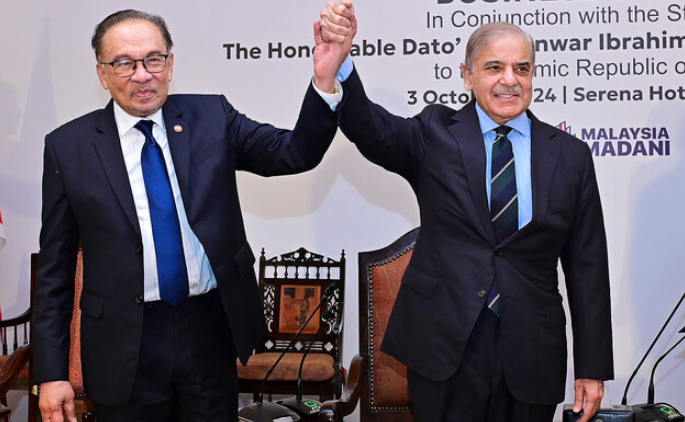
Kuala Lumpur (Web Desk): Pakistan and Malaysia have jointly urged the international community to ensure an immediate, unconditional, and permanent ceasefire in Gaza, calling for the lifting of the blockade, protection of civilians, and uninterrupted humanitarian access for those in need.
In a joint statement issued on Tuesday at the end of Prime Minister Muhammad Shehbaz Sharif’s three-day visit to Malaysia from October 5 to 7, the two countries welcomed global efforts toward a realistic and lasting resolution of the issue of Palestinian statehood.
During their bilateral meeting held on October 6, Prime Minister Shehbaz Sharif and his Malaysian counterpart, Anwar Ibrahim, reviewed the state of relations between their countries and exchanged views on regional and international developments.
They discussed current geopolitical tensions, particularly the crisis in the Middle East and the situation in Myanmar’s Rakhine State affecting the Rohingya Muslims.
Both leaders strongly denounced the ongoing genocide in Gaza and reaffirmed their unwavering support for the Palestinian people’s right to self-determination and the establishment of an independent and viable state based on pre-June 1967 borders with Al-Quds Al-Sharif as its capital.
The two sides agreed to hold the next Joint Commission Meeting at the foreign minister level at a mutually convenient time to further strengthen cooperation. They reiterated their determination to promote balanced and sustainable economic relations through improved market access, business facilitation, and effective implementation of the Malaysia–Pakistan Closer Economic Partnership Agreement (MPCEPA).
Malaysia expressed its willingness to increase palm oil exports to Pakistan and pledged to maintain a stable and environmentally responsible supply chain. Both countries also agreed to enhance collaboration in the halal industry in view of the rising international demand for halal goods and services.
The leaders highlighted the need to encourage sustainable agriculture through joint research, innovation, and modern production methods.
They expressed satisfaction with the progress achieved under the Joint Committee on Defence Cooperation (JCDC) established in 1997, which has significantly strengthened military and defence ties.
Both sides committed to deepening cooperation in defence technology, science, and industry through knowledge exchange and technology transfer.
The two countries agreed to broaden cooperation in education, including technical and vocational training, and to strengthen institutional linkages.
Recognising the importance of aviation in promoting greater connectivity, the leaders decided to enhance air travel services and explore additional flight routes to facilitate business, tourism, and people-to-people contact.
The meeting also focused on expanding collaboration in healthcare, pharmaceuticals, and medical devices to advance public health and commercial opportunities.
Malaysia extended a warm invitation to Pakistani tourists as part of its “Visit Malaysia 2026” and “Malaysia Year of Medical Tourism 2026” initiatives, and both sides agreed to promote tourism and cultural exchanges.
Acknowledging the contributions of the Pakistani community in Malaysia, both leaders reaffirmed their commitment to further cooperation in labour, technical training, and skills development. They also agreed to strengthen collaboration in renewable energy, climate resilience, and energy transition through joint research, investment, and knowledge sharing.
The two sides expressed their intent to enhance cooperation in science, technology, and innovation, with a focus on artificial intelligence and digital transformation. They also underscored the importance of working together in disaster management, humanitarian assistance, and post-disaster recovery efforts.
Both countries resolved to intensify collaboration in cybersecurity and combating transnational crimes, including terrorism, terrorism financing, and cybercrime, through continued information and expertise exchange.
They reaffirmed their active engagement in multilateral forums such as the United Nations, Organisation of Islamic Cooperation (OIC), and Developing-8 (D-8), reiterating their shared commitment to strengthening the unity of the Muslim Ummah and promoting the true principles of Islam.
The leaders also reiterated their support for a peaceful and stable Afghanistan and called for constructive engagement with the interim Afghan authorities to counter terrorism and prevent the use of Afghan territory against other nations. They stressed the importance of sustained humanitarian and capacity-building assistance for the Afghan people.
Condemning all forms of Islamophobia, xenophobia, and incitement to hatred, both countries urged the global community to act collectively against discrimination and violence based on religion or belief.
They welcomed the adoption of UN General Assembly resolutions 76/254 and 78/264, which reaffirm the importance of the International Day to Combat Islamophobia, and encouraged the UN Secretary-General to develop a practical action plan to address the issue.
They also welcomed the appointment of Miguel Ángel Moratinos Cuyaubé of Spain as the UN Special Envoy to Combat Islamophobia on May 7, 2025, and expressed support for his role in promoting tolerance and peaceful coexistence.
PM Shehbaz reaffirmed Pakistan’s strong backing for Malaysia’s chairmanship of ASEAN and expressed confidence in its ability to guide the regional bloc toward deeper integration, peace, and prosperity.
Neo News | Copyright © 2026