Thu, September 17, 2026

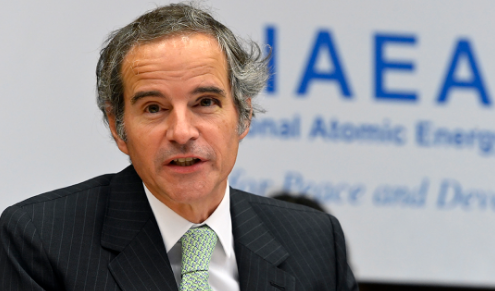
Vienna (Web Desk): International Atomic Energy Agency (IAEA) Director General Rafael Grossi said on Friday that ongoing discussions between the United States and Iran are approaching a possible understanding on a broad framework concerning Iran’s nuclear programme.
Following a session of the IAEA Board of Governors, Grossi told reporters that the agency is not directly participating in the negotiations but continues to stay in communication with both sides. He indicated that the talks appear to be converging on a preliminary structure that would outline how the nuclear issues could be managed while allowing further time to resolve technical details.
“Our sense is that they seem to be pretty close to agreeing on what I would describe more with regards to the nuclear … to sort of a framework, organizational structure to give themselves time to look into the different problems," he said.
Grossi reiterated that the IAEA has been making consistent efforts to re-establish full verification operations in Iran and underlined that Iran’s commitments under its agreements with the agency remain valid.
He highlighted that access for inspections and the provision of information remain key concerns in the current environment, though some level of monitoring has continued at certain sites designated by Iranian authorities.
"The issue here is multiple, because Iran has a number of obligations in terms of informing us and giving us access for our inspection work,” he said. “It is clear that under war circumstances, this is not possible, but there has been quite a long ceasefire.”
He further explained that inspections have continued selectively, depending on access granted by Iran, noting that the agency operates with limited discretion over what it is allowed to review. According to him, Iran’s stockpile of highly enriched uranium remains one of the most critical elements in any prospective arrangement.
Grossi said that possible solutions being considered include transferring the material out of Iran, diluting it, or retaining it inside the country under strict monitoring by the agency, stressing that any final decision would rest with political leadership. He added that the immediate priority should be for IAEA inspectors to physically verify the existing stockpile.
Ahead of the Board of Governors meeting, he also raised concerns about the protection of nuclear infrastructure during periods of conflict, stressing that such installations must never come under attack.
"Regardless of where they are located around the world, nuclear facilities should never be attacked," he said.
During a recent visit to the Gulf region, where he met regional officials and inspected facilities including the Barakah Nuclear Power Plant in the United Arab Emirates, which was hit by a drone on May 17, Grossi reiterated strong condemnation of any strikes on peaceful nuclear sites.
"Attacks on nuclear facilities devoted to peaceful purposes are unacceptable. I solemnly reiterate my calls for the parties in this conflict and in all conflicts to respect the seven indispensable pillars for ensuring nuclear safety and security during a conflict," Grossi said.
He urged all parties to exercise maximum restraint, warning that any military involvement around nuclear facilities carries serious and unacceptable risks, particularly in terms of environmental contamination and public safety if radiation is released.
Grossi stressed that the International Atomic Energy Agency applies uniform principles without exception across all countries and situations.
"There are no double or triple standards here for the IAEA. An attack on any facility, wherever it is located, is unacceptable, a no-go, taboo," he said.
He further warned that any significant radioactive release resulting from an attack on an operating nuclear power plant could have severe environmental and humanitarian consequences. Concluding his remarks, he emphasized that diplomacy remains the only viable route forward.
"The only sustainable path to peace, stability and cooperation is one grounded in dialogue and diplomacy. This is what we are here for," Grossi added.
Neo News | Copyright © 2026