Thu, September 17, 2026

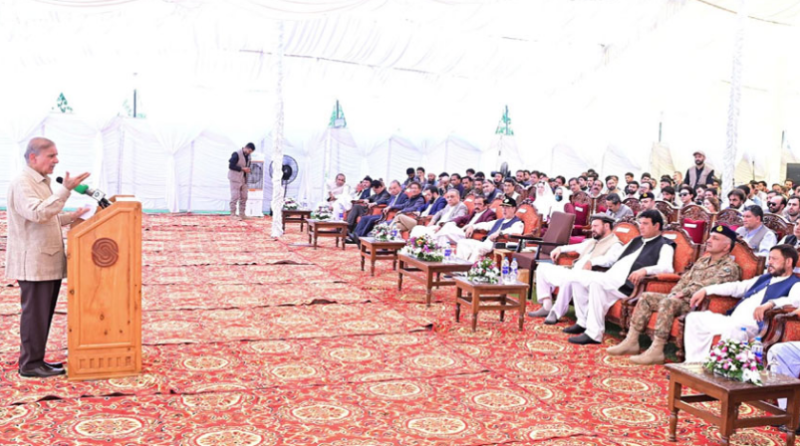
Gilgit-Baltistan (Web Desk): Prime Minister Shehbaz Sharif, during a recent visit to Gilgit-Baltistan (G-B), unveiled a relief package worth Rs4 billion aimed at supporting communities devastated by flash floods triggered by intense cloudbursts.
The announcement was made at a cheque distribution ceremony where financial assistance was given to victims and their families.
Under this relief initiative, families who lost loved ones received Rs1 million each, those with serious injuries were granted Rs500,000, individuals with minor injuries were given Rs200,000, and people whose homes were destroyed were allocated Rs500,000 to aid reconstruction efforts.
Addressing the gathering, the prime minister highlighted the growing frequency and severity of climate-induced disasters in Pakistan, a country that contributes little to global carbon emissions yet ranks among the most climate-vulnerable nations worldwide.
He emphasized the urgent need for preparedness, pointing out the long-standing inaction on a flood early warning system that has existed on paper for the past seven years but remains unimplemented. Stressing that reactive measures alone are insufficient, he urged proactive planning to mitigate future disasters.
During his visit, Shehbaz Sharif also announced a 100-megawatt solar energy project, expected to be completed within the year. This initiative aims to reduce the region’s dependence on traditional energy sources during the harsh winter months when electricity shortages are most acute.
In addition, he revealed plans for the establishment of a Danish School in the area, designed to offer merit-based, high-quality education to children from economically disadvantaged families. Calling education a long-term investment rather than an expense, the prime minister underscored its role in shaping the country’s future.
The prime minister formed a special committee, led by Federal Minister for Kashmir and G-B Affairs Engineer Amir Muqam and Advisor Rana Sanaullah, to coordinate efforts with the Gilgit-Baltistan governor and chief minister to resolve local challenges and monitor rehabilitation activities.
He also called upon the regional administration to contribute its share in the relief and reconstruction efforts.
Earlier after his arrival, chairing a high-level meeting regarding post-flood recovery and long-term resilience, PM Shehbaz stressed the urgent need for proactive measures to mitigate the effects of extreme weather patterns.
He was received by Governor Syed Mehdi Shah, who provided a detailed briefing on the destruction across various districts.
The premier expressed deep sorrow over the loss of lives and livelihoods, and assured that the federal government would stand by the people of Gilgit-Baltistan during this difficult time.
PM Shehbaz emphasized the installation of an advanced alert system tailored to the seasonal forecasts in tourist hotspots, which are especially vulnerable during the monsoon season.
He also directed authorities to initiate the resettlement of communities living along natural water flow routes to avert future catastrophes.
Recognizing the accelerating impact of climate change, the prime minister called for the development of a comprehensive early warning mechanism, swift emergency response systems, and infrastructure capable of withstanding harsh environmental conditions.
He urged the National Disaster Management Authority (NDMA) and the Ministry of Climate Change to jointly set up a forecasting and monitoring hub in Gilgit-Baltistan within the coming months.
PM Shehbaz directed the NDMA to work in close coordination with provincial administrations and other relevant bodies to ensure the effectiveness of relief and rescue operations.
He stressed that all rehabilitation efforts for those affected by the recent floods must be completed without delay.
A thorough survey of road damage and infrastructure was also ordered, with a directive to prioritize the restoration of transport and communication systems in the affected regions.
The prime minister expressed condolences over the tragic loss of life due to the severe rainfall and flooding.
He underscored Pakistan’s limited role in contributing to global carbon emissions, yet acknowledged the disproportionate burden the country faces as one of the most climate-vulnerable nations.
“Despite contributing almost nothing to global warming, Pakistan continues to suffer extensive damage from climate-related disasters every year”, PM Shehbaz noted.
Commending the timely and coordinated response from the NDMA, provincial disaster authorities, the Ministry of Communications, local officials, and emergency services, he instructed the NDMA to provide all necessary support to the Gilgit-Baltistan government to expedite recovery efforts.
The meeting included briefings from the provincial leadership and NDMA Chairman on the devastation caused by heavy rainfall, especially the cloudbursts in Thak-Babusar, Thor, Kundus, and Ishkoman on July 21, 2025.
It was reported that these intense rains led to widespread damage affecting both residents and tourists. Rescue teams managed to evacuate over 600 people, with roads cleared and reopened swiftly to restore access.
Emergency shelters were set up in five locations, while ten helicopters and two C-130 aircraft were deployed to airlift stranded individuals to safety.
Personnel from the Pakistan Army, NDMA, GBDMA, local police, Rescue 1122, and medical staff took part in the operation. The Ministry of Communications provided an update on the status of roads and bridges impacted by the flooding, and the prime minister instructed that all reconstruction efforts incorporate climate-resilient designs.
The Ministry of Climate Change also presented progress on the deployment of a Glacial Lake Outburst Flood (GLOF) early warning system.
The premier called for the completion of its installation within two months and mandated third-party evaluation to ensure reliability.
The premier assigned the Minister for Water Resources to remain in Gilgit-Baltistan to oversee ongoing consultations and planning for improved water management strategies.
Among those present at the meeting were federal ministers including Engineer Amir Muqam, Abdul Aleem Khan, Attaullah Tarar, Mian Moeen Wattoo, and Dr. Musadik Malik, along with Adviser Rana Sanaullah and Coordinator Shabbir Ahmed Usmani.
Gilgit-Baltistan governor Syed Mehdi Shah, Chief Minister Gulbar Khan, Chairman NDMA Inam Haider Malik, and other senior government representatives also attended the meeting.
Neo News | Copyright © 2026