Thu, September 17, 2026

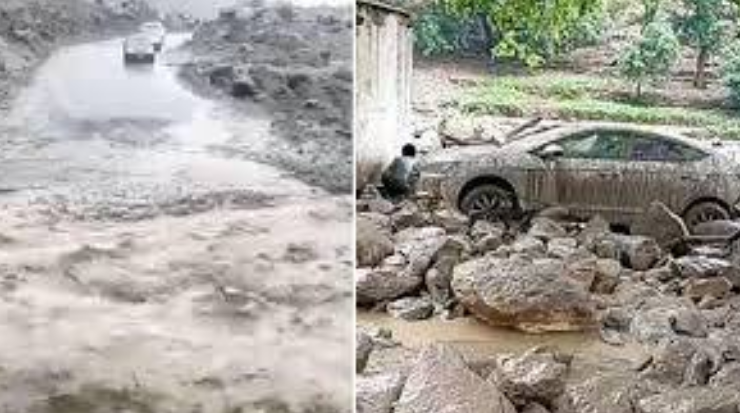
Gilgit (Web Desk): Heavy rains and flash floods have caused severe devastation in Gilgit-Baltistan, with reports indicating that between 10 and 15 people have gone missing after being swept away by floodwaters in the Babusar area, according to Faizullah Firaq, the spokesperson for the Gilgit-Baltistan government, on Wednesday.
Authorities have issued a firm advisory strongly discouraging tourists from visiting the region at this time.
Speaking to a private news channel, Faizullah stated that the relentless downpours and flooding have resulted in substantial damage to both life and property.
He confirmed that all tourists stranded along Babusar Road have been safely evacuated and are now receiving free accommodation provided by local hotel owners and government support. Currently, all access routes to Naran and Kaghan remain closed, while the Karakoram Highway is obstructed at two locations, leaving numerous travelers stranded. However, the Silk Route is still open for small vehicles, and restoration efforts are underway up to Bisham.
Faizullah urged the public to refrain from traveling to Gilgit-Baltistan until conditions stabilize. He also mentioned that Chief Minister Gulbar Khan is expected to visit the most affected areas, especially Babusar, to evaluate the situation on the ground.
In Diamer district, a state of emergency has been declared following flash floods that have claimed five lives. Earlier flooding washed away more than 30 vehicles, completely destroying 10 to 15 of them, and rendered 7 to 8 kilometers of Babusar Road unusable. Four connecting bridges, two mosques, and over 50 homes were also destroyed, while fiber optic and power lines suffered damage, disrupting communications. As a result, tourists in Thak and Babusar lost contact with their families.
Meanwhile, the Pakistan Meteorological Department (PMD) has issued warnings for 23rd and 24th July, forecasting heavy rains likely to trigger flash floods in local streams and nullahs across various regions including Chitral, Dir, Swat, Shangla, Mansehra, Kohistan, Abbottabad, Buner, Charsadda, Nowshera, Swabi, Mardan, Murree, Galliyat, Islamabad, Rawalpindi, Dera Ghazi Khan’s hill torrents, northeast Punjab, and Kashmir.
Widespread monsoon activity across Pakistan is being driven by a seasonal low-pressure system over northwest Balochistan combined with moist air currents from the Arabian Sea. A westerly wave is also impacting the northern parts of the country, contributing to unstable weather and increasing the risk of flash floods, landslides, and infrastructure damage. Urban flooding remains a concern in cities such as Islamabad, Rawalpindi, Gujranwala, Lahore, Sialkot, Sargodha, Faisalabad, Okara, Nowshera, and Peshawar, where heavy rain may overwhelm drainage systems.
Local authorities are vigilantly monitoring low-lying urban areas for flooding risks as drainage networks struggle to cope with the increased moisture and seasonal runoff. Karachi is forecast to experience thunderstorms with rain, according to a fresh PMD warning for Sindh’s port city, while sunny weather is predicted for Thursday.
On Friday, partly cloudy skies are expected without rain. Coastal areas like Thatta may receive light showers, while southern Sindh continues to endure hot and humid conditions.
In mountainous regions including Khyber Pakhtunkhwa, Murree, Galliyat, Kashmir, and Gilgit-Baltistan, the threat of landslides and mudslides remains significant, heightening the risk of road closures and disruptions to transport. PMD officials have advised against non-essential travel in these vulnerable areas during the forecast period.
Forecasts for Wednesday and Thursday suggest that rain, wind, and thunderstorms are likely in Kashmir, Khyber Pakhtunkhwa, Islamabad, Punjab, Gilgit-Baltistan, and northeast Balochistan, with particularly heavy rainfall expected in upper Khyber Pakhtunkhwa, Gilgit-Baltistan, the Pothohar region, northeast Punjab, and Kashmir.
Recent rainfall measurements include 49 mm in Muzaffarabad and 16 mm in Kotli within Kashmir. In Khyber Pakhtunkhwa, Kakul recorded 31 mm and Balakot 26 mm, while Bagrote in Gilgit-Baltistan reported 9 mm of rain.
Neo News | Copyright © 2026