Thu, September 17, 2026


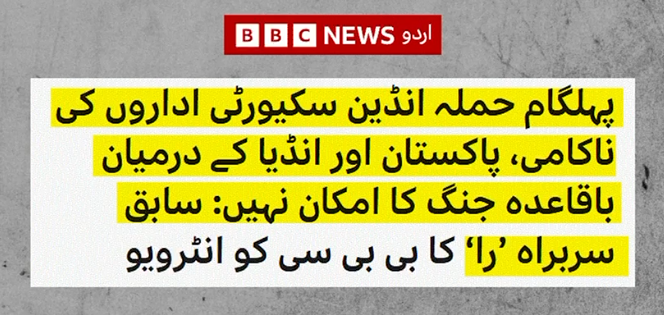
Islamabad (Web Desk/Agencies): Amarjit Singh Dulat, former head of India’s Research and Analysis Wing (RAW), has labeled the recent attack in Pahalgam a major security failure.
In an interview with the BBC, Dulat stated bluntly, “There was no security in Pahalgam,” pointing to what he described as glaring lapses in protection in the area.
He further warned that if evidence related to the attack were to be made public, it could potentially draw international attention and scrutiny to the issue. According to Dulat, the incident had no involvement from local Kashmiris, and he condemned the violence being inflicted on Kashmiri Muslims across India, calling it unjust.
Dulat also emphasized the dangers of escalating tensions in the region, cautioning that war should be viewed only as a last resort. “War is the last and worst option, as war means nuclear war,” he said, underscoring the high stakes of conflict in South Asia.
Following his statements, several defense analysts have suggested that Dulat’s remarks point toward the possibility that the Pahalgam incident was a false flag operation.
They argued that the ruling Bharatiya Janata Party (BJP) has a pattern of stoking extremist sentiment among Hindus and allegedly using such attacks for political leverage during its tenure in power.
Earlier on Thursday, the BBC while, quoting sources, reported that the RAW has been implicated in orchestrating a false flag operation in Pahalgam.
This revelation came in the wake of a sensitive document that reportedly leaked through messaging platform Telegram, igniting controversy over India’s covert strategies.
According to insiders, the contents of the leaked document strongly indicate the direct involvement of Indian state machinery in the Pahalgam incident.
The mishandling of the narrative, as outlined in the document, appears to have compromised the entire operation.
Sources noted that a discrepancy between the documented instructions and the way the plan was executed led to the exposure of the false flag.
Specifically, the document advised that anti-Pakistan rhetoric should be circulated in the media exactly 36 hours following the attack.
“The narrative of the incident should be structured in such a way that it emerges as an attack on the state and non-Muslims,” it stated.
However, Indian media outlets prematurely implicated Pakistan immediately after the incident, undermining the coordinated media campaign RAW had intended to orchestrate.
The development comes as tensions soar between nuclear-armed neighbours after a deadly terror attack in Pahalgam, Indian Illegally Occupied Jammu and Kashmir (IIOJK), in which 26 tourists were killed.
On April 23, India announced the unilateral suspension of the Indus Waters Treaty (IWT)—a landmark water-sharing accord mediated by the World Bank in 1960.
Despite enduring multiple wars and diplomatic crises, the treaty has remained a rare symbol of cooperation between the two nations.
In retaliation, Pakistan declared on April 24 its intention to consider suspending the Simla Agreement of 1972, a foundational framework for bilateral relations, and warned of the potential closure of its airspace to Indian aircraft.
While Indian authorities have alleged possible cross-border involvement in orchestrating the Pahalgam attack, no definitive evidence has been released to support such claims.
Pakistan, for its part, has categorically denied any involvement and has called for an independent international inquiry to ascertain the facts surrounding the incident.
On April 26, Prime Minister Shehbaz Sharif, while reiterating Pakistan’s strong condemnation of terrorism in all its forms and manifestations, said that Pakistan as a responsible country is open to participate ‘in any neutral, transparent and credible investigation’ into Pahalgam incident.
However, he had expressed regret over the conduct of Pakistan’s eastern neighbour, accusing it of a continued pattern of exploitation and baseless accusations without credible evidence or transparent investigations.
PM Shehbaz had stressed that while Pakistan prefers peace, this inclination should never be mistaken for weakness, the prime minister made it clear that the nation will never compromise on its dignity or national security.
Neo News | Copyright © 2026