Thu, September 17, 2026

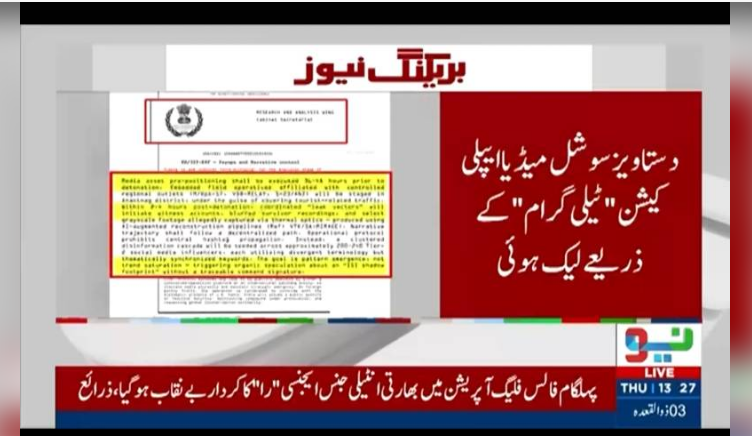
Islamabad (Web Desk): In a startling development, sources have revealed that the Indian intelligence agency, Research and Analysis Wing (RAW), has been implicated in orchestrating a false flag operation in Pahalgam.
This revelation comes in the wake of a sensitive document that reportedly leaked through messaging platform Telegram, igniting controversy over India’s covert strategies.
According to insiders, the contents of the leaked document strongly indicate the direct involvement of Indian state machinery in the Pahalgam incident.
The mishandling of the narrative, as outlined in the document, appears to have compromised the entire operation. Sources noted that a discrepancy between the documented instructions and the way the plan was executed led to the exposure of the false flag.
Specifically, the document advised that anti-Pakistan rhetoric should be circulated in the media exactly 36 hours following the attack.
“The narrative of the incident should be structured in such a way that it emerges as an attack on the state and non-Muslims,” it stated.
However, media outlets prematurely implicated Pakistan immediately after the incident, undermining the coordinated media campaign RAW had intended to orchestrate.
The content of the document points to a broader directive structure, suggesting RAW had been operating under instructions from higher authorities.
According to sources, the unexpected leak of the document on social media appears to stem from internal dissent within RAW, possibly reflecting anti-Hindutva sentiments among some of its members.
The Indian government has reportedly initiated a probe into how such a sensitive document was disseminated online.
The document, ominously titled “Psy Ops” and Narrative Control, provides detailed insight into the manipulation strategies intended for the aftermath of the Pahalgam incident. It outlines how RAW was to activate its media network to shift the narrative, stating: “Media assets will be mobilized at the scene of the incident 36 to 48 hours before the attack.”
Furthermore, the operation was allegedly centered in the Anantnag district, under the pretense of monitoring tourist activity. The document details that, “On the pretext of monitoring the movement of tourists, our field operators will be deployed at specific places.”
The operation was to employ artificial intelligence for rapid witness testimony collection within hours. “Within two to four hours of the attack, statements of witnesses will be taken under the artificial intelligence system,” the document read.
The plan also involved the recreation of incident visuals and a targeted misinformation campaign using a decentralized online strategy.
“Pictures of the incident will be recreated with the help of blurred videos and a misinformation campaign will be run through more than 200 social media accounts instead of a central hashtag,” the leaked document stated.
To lend weight to the accusation against Pakistan’s Inter-Services Intelligence (ISI), the document instructed the Northern Command to fabricate and link supposed ISI correspondence to the scene.
“The Northern Command will link correspondence found near the attack site to ISI and the Northern Command will forensically leak alleged ISI documents,” it said.
The timing of the operation was reportedly chosen to coincide with the visit of US Vice President JD Vance to India, aiming to leverage international support.
The document added: “The operation has been planned keeping in mind presence of US Vice President JD Vance in India and international community will also be appealed for solidarity on counter-terrorism.”
The document also outlined a contingency plan in case of exposure, naming an alternative setup in Shopian. “Alternative system activated in Shopian will act as a backup plan in case of leak,” it said.
Moreover, it included military directives for controlling territory near the Line of Control (LoC), warning against provoking international intervention.
It noted: “Pakistan’s rapid advance on LoC may challenge India’s control and violation of 1.3 km limit may invite UN or Chinese mediation.” Accordingly, RAW instructed its operatives:
“Instructions were issued to limit Indian advance to 1.2 km across line of control.”
The document also warned of potential diplomatic resistance and the need to maintain a backup strategy involving international coordination. “Potential resistance or pressure from neutral countries may be faced. Alternative line TANGO-ECHO will be kept active through code INDOPACOM,” the document stated.
Defense analysts have described the Pahalgam incident as a deliberate and calculated mission authorized by RAW.
According to them, this disclosure once again exposes the Indian government's antagonistic stance toward Kashmiris. One expert noted that “targeting innocent civilians to achieve political objectives was the old habit of Modi government.”
The leak, in the view of several analysts, adds weight to the belief that the Pahalgam attack was not an isolated case but another in a series of false flag operations.
Neo News | Copyright © 2026