Thu, September 17, 2026

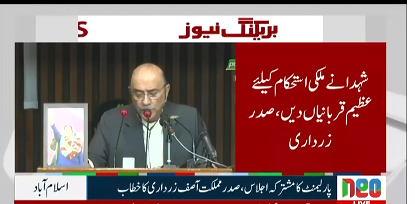
Islamabad (Web Desk): President Asif Ali Zardari on Monday said that Pakistan will not “allow any entity, domestic or foreign to use neighbouring territory to destabilise our peace”.
Addressing the joint sitting of Parliament, the president described war as a measure of last resort and urged India to move from conflict to constructive dialogue—or face another humiliating defeat. He warned that Pakistan had already shown both India and Afghanistan only a fraction of its capabilities.
“Make no mistake. We are ready for you. My message to them is to move away from war theatres to meaningful negotiating tables because that is the only path for regional security… India must listen to us attentively: Pakistan will continue to give its fullest diplomatic and moral support to the just cause of the people of Jammu and Kashmir.”
The session, co-chaired by Senate Chairman Syed Yousuf Raza Gilani and National Assembly Speaker Sardar Ayaz Sadiq, was attended by Prime Minister Shehbaz Sharif, parliament members, First Lady Aseefa Bhutto Zardari, provincial governors, chief ministers, and diplomats.
Speaking at the start of the new parliamentary year for the ninth time, President Zardari discussed national, regional, and international issues including Kashmir, Palestine, Gulf tensions, Maarka-e-Haq and Ghazab lil-Haq operations, Indian violations of the Indus Waters Treaty, the economy, provincial autonomy, and poverty. He emphasized that South Asia cannot be safe until Kashmiris achieve freedom from Indian occupation.
President Zardari condemned the war against Iran, reaffirmed Pakistan’s support for its sovereignty and territorial integrity, and expressed condolences over the martyrdom of Supreme Leader Ayatollah Khamenei. He also criticized attacks on the UAE, Bahrain, Jordan, Kuwait, Qatar, and Saudi Arabia, urging negotiated solutions to prevent further crisis.
“The sooner stability returns to the region, the sooner the world can go back to the business of rebuilding lives and fractured trust. I urge the need to exercise maximum restraint, to uphold international law, and to respect the territorial integrity of all brotherly nations,” he said.
Regarding Maarka-e-Haq, the president said Pakistan first exercised restraint amid Indian violations but later responded with exceptional professionalism, turning aggression into a strategic triumph. Similarly, after Afghan Taliban attacks on February 26, the military acted decisively.
“The political leadership stood united. The people stood resolute,” he said, thanking all security forces for their efforts. Visiting the families of fallen soldiers, he recalled the grief of losing his wife, Shaheed Mohtarma Benazir Bhutto, emphasizing that the victories reflected national resolve as well as military and diplomatic success.
Responding to Indian threats of another war, he said he advocates peace but warned: “At the same time, I would also say that any aggressor should prepare for another humiliating defeat…Pakistan is a responsible nuclear state…At the same time, we are a state that defends itself decisively when required.”
On Ghazab lil-Haq, he noted that Pakistan pursued diplomacy to prevent military escalation from Afghan terrorist incursions. “For us, war is always the last option. No state accepts serial attacks on its soil… We have let both India and Afghanistan see a fraction of our capabilities,” he said, emphasizing that Pakistan’s territory is sacred.
He criticized the Afghan Taliban for sheltering terrorist groups like Al-Qaeda, BLA, and TTP, urging them to dismantle these organizations instead of being used by others as a battlefield. Pakistan, he said, has always engaged with the Afghan people in dialogue.
President Zardari praised recent efforts with the US to de-escalate Pakistan-India tensions and highlighted new avenues for cooperation, expecting greater progress in the coming year. He also lauded deepened China-Pakistan relations, noting CPEC 2.0 would transform infrastructure, and expressed gratitude to Xi Jinping for supporting Pakistan during Maarka-e-Haq.
Acknowledging strengthened ties with Gulf countries, Azerbaijan, and Turkey, he called the Pakistan-Saudi Strategic Mutual Defence Agreement a regional milestone. He reiterated support for Palestine, advocating for an independent state with pre-1967 borders and Al-Quds Al Sharif as its capital, and congratulated Bangladesh on holding elections and forming a new government.
He condemned India’s unilateral actions affecting the Indus Waters Treaty, calling them acts of hydro-terrorism that threaten Pakistan’s agriculture and violate international law, and vowed Pakistan would defend its water rights firmly.
On governance, he emphasized that provincial autonomy strengthens participatory decision-making and called for effective coordination in natural resources, fiscal distribution, energy, and water management, anticipating a fair National Finance Commission Award.
He highlighted Balochistan, stressing that while insurgencies fueled by foreign proxies are being addressed, genuine social and economic grievances of the people are also being resolved.
President Zardari praised recent economic improvements but urged focus on inclusive growth, jobs, and relief for vulnerable groups. He called for transparency in taxation, adoption of technology, energy reforms, climate-resilient agriculture, and coordinated water management.
He also stressed expanding the Benazir Income Support Program, removing barriers to women’s progress, and ensuring their safety, digital access, and financial independence.
Highlighting Pakistan’s democratic legacy, he credited Quaid-e-Azam Muhammad Ali Jinnah, Shaheed Zulfikar Ali Bhutto, and Shaheed Mohtarma Benazir Bhutto for shaping the nation.
The president noted that the Presidency, through the 18th Amendment, now serves as a symbol of unity and guardian of the Constitution.
He outlined the priorities for the new parliamentary year: protecting sovereignty, combating terrorism, consolidating economic stability, preserving unity, institutionalizing reforms, translating macroeconomic gains into household relief, safeguarding borders, and creating domestic opportunities.
Neo News | Copyright © 2026