Thu, September 17, 2026

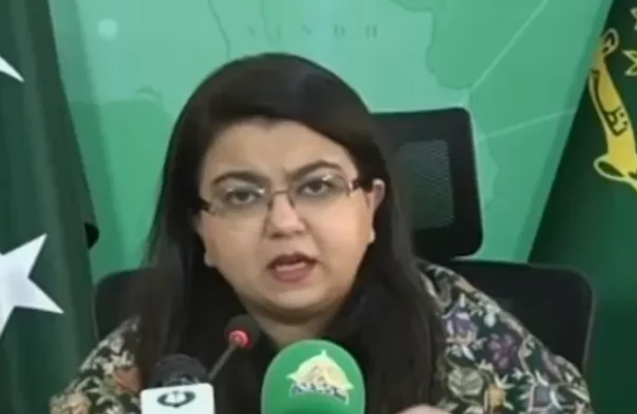
Islamabad (Web Desk): Federal Minister for Information Technology and Telecommunication, Shaza Fatima Khawaja, on Friday addressed the country’s ongoing internet speed problems, pointing to a critical shortage of available spectrum as the root cause. She unveiled major steps to tackle these issues, including a forthcoming spectrum auction and the groundwork for the nation’s first 5G services.
During a press briefing in Islamabad, the minister explained that Pakistan’s entire mobile internet network operates on just 274 megahertz of spectrum for nearly 240 million people.
She compared the situation to “trying to run four-lane traffic on a two-lane road” and said this is the main reason why internet speeds remain slow. She also noted that Pakistan has one of the lowest spectrum allocations in the region, while neighboring Bangladesh — with a smaller population — has nearly 600 megahertz available.
Shaza said the federal cabinet has approved a framework for a major spectrum auction, which will add about 600 megahertz of spectrum for telecom operators.
She said the auction is expected within the next few weeks and will include seven spectrum bands, five of which will be available in Pakistan for the first time. The minister added that this expansion should noticeably improve 3G and 4G services within three to four months, while 5G connectivity is expected to launch within six months in provincial capitals, including Islamabad.
“Our focus is not just faster internet, but a network ready for the future,” she said, noting that the government is collaborating with the Pakistan Telecommunication Authority and international advisors to ensure the adoption of global best practices.
The minister emphasized that internet access is no longer a luxury but a critical infrastructure that underpins economic growth, national security, education, healthcare, agriculture, and exports. She highlighted Pakistan’s status as the fourth-largest freelancing economy in the world and noted that the IT sector is growing at roughly 20 to 21 percent per year.
Shaza credited the prime minister and the finance ministry for supporting telecom reforms, including removing right-of-way charges across federal and provincial departments, which she said has lowered costs and encouraged investment in fiber networks
In another development, she announced that the cabinet has approved the Mobile Virtual Network Operator (MVNO) policy, allowing new mobile brands to enter the market without building their own networks.
Under this policy, MVNOs will lease capacity from existing operators and offer services under their own brands, promoting competition and potentially lowering consumer prices.
“This will give users more options, better packages, and greater affordability,” she said, noting that global experience shows MVNOs strengthen markets and attract foreign investment.
The minister also said the PTA has greenlighted district-level ISP licenses, enabling local cable operators and smaller companies to legally provide internet services in villages, small towns, and underserved areas.
“This step will expand legal fiber coverage and bring connectivity to communities beyond the major cities,” she remarked.
The minister highlighted Pakistan’s growing international internet capacity, including joining the world’s longest submarine cable system (SMW-6), with two additional undersea cables expected to become operational this year.
She explained that these new links will reduce dependence on a few routes and limit disruptions caused by international cable outages, like those recently reported in the Red Sea.
Responding to questions about internet restrictions, the minister clarified that temporary shutdowns occur only under security instructions from the Interior Ministry and are not an IT Ministry policy.
“Human lives come first,” she said, stressing that such measures are used only in extreme situations.
Shaza Fatima expressed confidence that after the spectrum auction, users will see a noticeable improvement in internet quality within three to four months.
She described the reforms as “transformational” for Pakistan’s digital future and said, “These policies are designed not just for the short term, but to serve the country for decades to come.”
Neo News | Copyright © 2026