Thu, September 17, 2026

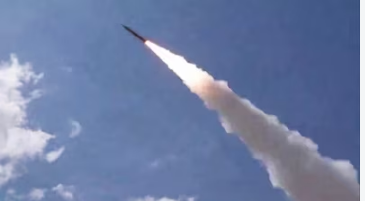
Amman (Web Desk/Agencies): Iran said on Monday that it had carried out missile strikes against US military installations in Jordan, describing the operation as retaliation for Washington’s first attack on Iranian territory in nearly a month and signalling a new escalation in the six-month-long conflict.
The Islamic Revolutionary Guard Corps (IRGC) said its forces fired ballistic missiles at two American military bases in Jordan, a close US ally, and claimed the attacks caused “heavy damage”. Jordan’s armed forces said they had intercepted eight missiles but did not specify where the projectiles originated.
The Iranian strikes followed a US military operation announced on Sunday, when Washington said it had targeted Iranian rocket launchers on Larak Island in the Strait of Hormuz.
The United States said the attack was designed to stop Iran from placing additional sea mines in the strategically vital waterway. The operation came only days after Washington said it had completed efforts to remove explosives from the strait.
“US forces took limited, precise action against IRGC mine laying forces posing an imminent threat in the Strait of Hormuz,” the US Central Command (Centcom) wrote on X.
????CLAIM: Iran’s Islamic Revolutionary Guard Corps (IRGC) claimed in a recent statement that strikes by U.S. forces to prevent the IRGC from placing mines in the Strait of Hormuz were an “act of aggression.” This claim is absolutely FALSE.
— U.S. Central Command (@CENTCOM) August 31, 2026
✅FACT: U.S. forces took limited,… pic.twitter.com/XLx8xNTHto
The IRGC said the American strikes caused “casualties” and described its subsequent assault on targets in Jordan as retaliation for what it called “US-Zionist aerial aggression”.
Iran’s Foreign Ministry also confirmed that Iranian forces had attacked US military bases in Jordan following the American operation against Larak Island.
According to the ministry, the US facilities in Jordan had been involved in launching and supporting the assault on Larak.
Iran defended the strikes as an act of “legitimate defence” while condemning the US military operation against the island.
Iran “strongly condemned the American military aggression on Larak”, and Iranian forces responded “in accordance with the inherent right of legitimate defence”, the ministry said.
The ministry further warned that Tehran would respond forcefully to any additional military action against it, adding that Washington and countries backing its operations would bear full responsibility for any escalation that followed.
Separately, the IRGC claimed it had launched a drone attack against the United Arab Emirates’ Al Minhad Air Base, Iranian state television reported. The Guards said the operation was carried out because of the Larak attack and that areas housing US personnel and helicopters were among the intended targets.
The UAE rejected the allegation, saying its forces had intercepted an Iranian drone over its territorial waters.
“Media reports regarding a missile attack on Al Minhad Air Base are baseless,” the Emirati defence ministry said in a statement on X.
Ministry of Defence Denies Reports of Attack on Al Menhad Air Base
— وزارة الدفاع |MOD UAE (@modgovae) August 31, 2026
The Ministry of Defence has denied media reports claiming that Al Menhad Air Base was targeted by missiles, confirming that such reports are false.
The Ministry affirmed that the Armed Forces remain on a high… pic.twitter.com/qVdCiYbNq2
The latest confrontation unfolded just as the US-Iran war reached its six-month milestone, despite a period of comparatively lower tensions in recent weeks.
During that period, the administration of US President Donald Trump had increasingly turned towards “economic warfare” against Iran instead of relying primarily on military operations.
Iran has effectively prevented normal shipping through the Strait of Hormuz, a crucial global maritime route. Before the conflict began with US and Israeli attacks on Iran on February 28, roughly one-fifth of the world’s oil supply moved through the waterway.
The latest exchange comes as Washington has intensified financial pressure on Tehran and businesses connected to it. The Trump administration has increasingly relied on sanctions as it moves away from direct military action.
US Treasury Secretary Scott Bessent told Reuters on Sunday that Washington was expected to introduce additional secondary sanctions on a weekly basis, with financial institutions initially in its sights.
“We’re starting with the banks, and we’re telling the banks it’s not okay to have Iranian money and to aid the regime,” Bessent said.
The United States on Friday imposed sanctions on UAE branches of Egypt’s Banque Misr, accusing them of having financial connections with Iran. Bessent said Washington could go further by removing an institution completely from access to the dollar-denominated financial system.
“You’re going to see a lot more of these every week,” Bessent told Reuters ahead of a gathering of G20 finance officials.
For months, countries including Pakistan and Qatar have been involved in diplomatic efforts aimed at ending the fighting and securing a lasting settlement.
The most severe phase of the conflict was halted by an April ceasefire, while the two sides signed a memorandum of understanding in June intended to support a final peace arrangement. Despite those steps, a comprehensive agreement has not been reached, while Washington has since described its campaign against Tehran as “economic warfare”.
The United States has also imposed a naval counterblockade around Iranian ports, putting additional strain on fuel availability inside Iran amid a domestic production shortage.
Although the April truce stopped the heaviest fighting, intermittent attacks have continued, particularly around the Strait of Hormuz, weakening prospects for a permanent peace deal.
The US military said its previous strike on Iran before Sunday’s operation took place on July 29 and was carried out in response to “an attempted surprise attack on US forces” in the region.
Earlier in July, Centcom conducted military operations against Iran for 13 nights in succession.
During the conflict, Iran has repeatedly responded by attacking US positions and installations belonging to American allies across the Gulf. Targets have been reported in Kuwait, Oman, Saudi Arabia and the United Arab Emirates, among other locations.
Iran’s effective closure of the Strait of Hormuz has had consequences far beyond the region, contributing to rising prices and shortages of fertiliser and energy supplies internationally.
Crude prices climbed following reports of the latest US strikes against Iran. Brent crude, the global benchmark, moved back above $90 per barrel, while US West Texas Intermediate crude exceeded $85.
The conflict has faced significant opposition among the American public, with US midterm elections scheduled for November that could potentially cost Republicans their control of Congress.
US Senator Jack Reed criticised President Trump’s handling of the war in a statement issued on Friday.
“Six months later, not a single objective has been achieved,” said Reed, the top Democrat on the Senate Armed Services Committee.
“Indeed, he has weakened our position in the Middle East and the world significantly.”
Neo News | Copyright © 2026