Thu, September 17, 2026

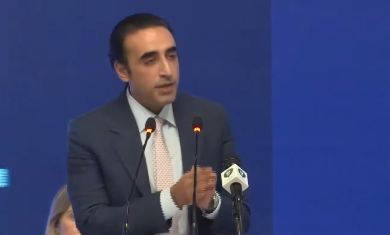
Islamabad (Web Desk): Pakistan Peoples Party (PPP) Chairman Bilawal Bhutto Zardari on Tuesday called for a new international convention against the "weaponisation of waterways", arguing that India's decision to place the Indus Waters Treaty (IWT) in abeyance was not simply a bilateral dispute but a challenge to international law, global peace and the rights of downstream states.
Addressing the session of the international seminar, The Indus Waters Treaty: A Key Instrument for Peace and Regional Stability, at the Jinnah Convention Centre in Islamabad, Bilawal urged Pakistan to pursue its legal, diplomatic, humanitarian, climate and deterrence cases simultaneously, while warning that attempts to manipulate shared rivers should be treated as a form of coercion rather than a technical disagreement.
Bilawal broadened the discussion beyond South Asia, arguing that water coercion should be recognised internationally as a distinct form of aggression. He proposed what he described as "a new international convention against the weaponisation of waterways", saying international law should explicitly prohibit states from exploiting civilian dependence on shared rivers.
The convention, he said, should establish that no upstream state could hold downstream populations hostage, that waterways could not be used as instruments of coercion or blackmail, and that "water is not a weapon", "thirst is not diplomacy", and "famine is not statecraft".
He argued that the principle should apply globally, citing waterways including the Strait of Hormuz, the Suez Canal, the Panama Canal, the Nile, the Tigris, the Euphrates and the Indus, arguing that waterways sustaining civilian populations and international stability "cannot be turned into weapons of coercion".
Bilawal also urged Pakistan to continue making its case internationally.
"We must take the climate case to every summit. We must take the diplomatic case to every capital," he said, adding that Pakistan should also present "the deterrence case to every strategist who thinks South Asia can survive casual experiments with the Indus".
Turning to domestic policy, he said Pakistan must strengthen water security regardless of India's actions. Projects already approved before India's unilateral move, including reservoirs, barrages, canals and flood protection systems, should continue, he said, because "Pakistan needs water security".
"We are strengthening Pakistan because we have a duty to survive," Bilawal said.
He also argued that the dispute formed part of a wider campaign against Pakistan, alongside border tensions, proxy violence, propaganda, economic pressure and hybrid warfare.
"A bullet is not the only weapon. A blockade is a weapon. A sanction can be a weapon. A lie can be a weapon. A proxy can be a weapon." "A river can be made into a weapon," the PPP chief noted.
Bilawal compared the strategic significance of the Indus River to the Strait of Hormuz, arguing that regional peace depended on preserving both.
"And no peace can be achieved between the United States and Iran with the Strait of Hormuz shut," he said. "Similarly, how can any ceasefire between India and Pakistan hope to endure without the IWT being restored?"
"A strait may carry the oil of nations," he added, "the Indus carries the life of nations."
He argued that the treaty had never been merely a mechanism for sharing water, but a cornerstone of peace between India and Pakistan.
Bilawal added that the agreement represented the principle that shared rivers could not be "left to the mercy of anger", warning that allowing a state to unilaterally suspend a binding international agreement would weaken confidence in treaties worldwide.
The former foreign minister repeatedly stressed that the debate extended far beyond water management. "This is not a technical dispute. This is not a clerical quarrel between commissioners.
This is not engineering," he said. "This is the weaponisation of water."
He described the Indus as central to Pakistan's identity and survival, saying it was "not a river on a map" but the source of the country's food security, agriculture and livelihoods. "It is our bread. It is our cotton. It is our wheat. It is our farmer at dawn. It is our mother drawing water. It is our children eating roti.
It is our worker in the mill," he said, adding, "To cut the Indus is not to pressure a government. It is to threaten a people."
Much of Bilawal's address focused on deterrence and how Pakistan should respond to any attempts to alter the flow of water guaranteed under the treaty.
He argued that deterrence should begin long before water was actually diverted, saying Pakistan should not wait "until the last drop has vanished" before recognising a threat.
"Pakistan's deterrence does not begin when the last drop has vanished," he said. "Deterrence begins when the adversary first moves towards the strangulation of a nation."
He argued that every stage of any effort to alter Pakistan's water supply — including surveys, tenders, canals, dams, diversions and what he described as the "legal fiction" of placing the treaty in abeyance — should be viewed as part of a process of strategic escalation rather than isolated administrative measures.
"If total water denial is an existential threat, then the path towards total water denial is not innocent," he said.
Drawing an analogy, he said that a noose does not become dangerous only when the neck is broken, "it becomes dangerous when it is tied."
Bilawal maintained that Pakistan sought peace but rejected suggestions that restraint meant accepting pressure over its water rights. "We seek restraint, but not national suicide."
He argued that attempts to control Pakistan's water should be understood as strategic coercion rather than disputes over engineering or irrigation. "We are not discussing canals. We are discussing the deliberate manufacture of famine, migration, economic collapse and national paralysis."
He warned that "a weaponised river can destroy a country in slow motion", arguing that the consequences of disrupting water supplies would extend far beyond agriculture.
Bilawal also called on Pakistan to combine diplomacy with national preparedness. "Law without power is a petition. Power without law is chaos. We need both," he said.
He urged the country to simultaneously pursue "the legal case, the diplomatic case, the humanitarian case, the climate case, and the deterrence case", while calling for greater national unity.
"The Indus belongs to the farmer of Sindh, the grower of Punjab, the worker of Karachi, the family of Balochistan, the mountains of Pakhtunkhwa, and the future of every Pakistani child."
He said Pakistan should continue investing in reservoirs, dams, barrages, flood management systems and water conservation, but emphasised that such measures should not be interpreted as accepting India's position.
"We preserve water because our future demands wisdom, not because we accept blackmail. We prepare for scarcity, but we do not legitimise strangulation."
Calling for political consensus, Bilawal said the Indus transcended party politics and provincial interests.
He contended that "the Indus belongs to Pakistan. It belongs to history," he said, urging "unity in parliament", "clarity at GHQ", "resolve in the foreign office, science in our universities", and "discipline in our people".
Concluding his address, Bilawal warned the international community against dismissing the issue as an administrative disagreement over water management, stating that the Indus was not only "an artery of Pakistan's economy" but the "bloodstream of Pakistan itself."
He ended by saying the river was older than both the flags of India and Pakistan, a witness to empires that have come and gone, "the river remains. Pakistan will remain."
"The Indus is not negotiable. The Sindhu is not for surrender."
Neo News | Copyright © 2026