Thu, September 17, 2026

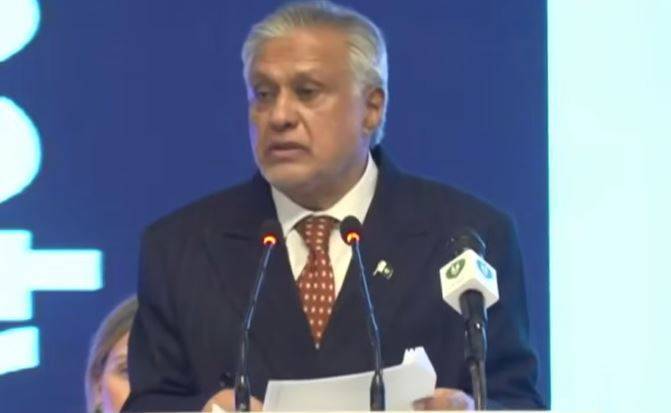
Islamabad (Web Desk): Deputy Prime Minister and Foreign Minister Senator Mohammad Ishaq Dar on Tuesday reaffirmed that Pakistan would defend its rights under the Indus Waters Treaty (IWT) by pursuing every legal and diplomatic option available, while warning that any attempt to deny the country its rightful share of water would pose a serious threat to regional peace and security.
Speaking at the International Seminar on the Indus Waters Treaty in Islamabad, he described water as much more than a natural resource, saying it was essential for human dignity, economic progress, food security and environmental protection.
DPM Dar noted that the Indus River system had sustained civilizations for thousands of years and preserving it remained a collective responsibility.
He said rivers shared by neighbouring countries should strengthen cooperation rather than become a source of conflict, adding that this principle was firmly recognised under international law.
Reflecting on the signing of the IWT in 1960 with the support of the World Bank, Dar said the agreement established a long-term legal framework for distributing the waters of the six rivers of the Indus Basin.
Under the Treaty, India was granted unrestricted access to the three eastern rivers, while Pakistan received rights over the three western rivers, with India allowed only limited use in accordance with the agreement.
Dar said Pakistan had overhauled its irrigation network and water management infrastructure in reliance on the Treaty’s permanence, despite facing significant losses after the eastern rivers no longer flowed into the country.
He said Pakistan had faithfully implemented the Treaty for over six decades, including during periods of war and strained political relations, because it believed international agreements should be respected in good faith.
Calling India’s decision to place the Treaty in abeyance unlawful and without legal foundation, the deputy prime minister said Pakistan categorically rejected the move and maintained that the Indus Waters Treaty remained fully valid, binding and enforceable.
He stressed that neither party had the authority to suspend or terminate obligations under a treaty that contained no such provision, adding that international law required states to honour their treaty commitments sincerely.
Referring to the Court of Arbitration established under the Treaty, DPM Dar said it had reaffirmed that the Indus Waters Treaty created a permanent legal framework governing the rights and responsibilities of both countries over the Indus Basin. He added that the court also confirmed that the agreement could not be suspended or terminated through unilateral action.
DPM Dar cautioned that disregarding binding international agreements whenever they became politically inconvenient would weaken trust in the international legal system and undermine peaceful relations between nations.
Expressing concern over developments since April 2025, he said that Pakistan had observed sudden fluctuations in the flow of the Chenab and Jhelum rivers, alongside continued efforts to expand infrastructure capable of controlling waters allocated to Pakistan.
Dar said that such actions threatened the cooperative framework that had helped maintain regional stability for more than sixty years.
The deputy prime minister maintained that any disputes relating to the Treaty should be addressed only through the dispute resolution mechanisms provided within the agreement, rather than through unilateral measures.
He said responsible states respected international law and treated treaty obligations as both legal and moral responsibilities.
DPM Dar warned that using shared water resources as a political weapon would create dangerous precedents, weaken the rules-based international order and harm cooperation between countries.
Describing water as the lifeline of more than 250 million Pakistanis, Dar said the country's agriculture, electricity generation, food security and economic growth depended on the uninterrupted flow of the western rivers allocated under the Treaty.
He urged India not to pursue actions that could fuel conflict or endanger regional peace, while reiterating Pakistan’s commitment to resolving all outstanding issues through dialogue, diplomacy and mechanisms provided under the Treaty.
Dar warned that Pakistan’s determination to safeguard its water rights should not be underestimated.
He said any attempt to deprive Pakistan of the water allocated to it under the Indus Waters Treaty would have far-reaching consequences for peace and security across the region.
Recalling the meeting of Pakistan’s National Security Committee chaired by Prime Minister Shehbaz Sharif after India announced its decision to place the Treaty in abeyance, Dar said the committee had unanimously declared that any diversion, disruption or reduction of Pakistan’s water share under the agreement would be regarded as an act of war.
"We mean it and we will ensure that our rights are neither compromised nor violated," he asserted.
Highlighting Pakistan’s commitment to regional harmony, Dar said the country had consistently promoted dialogue and peaceful resolution of disputes.
He also pointed to Pakistan’s diplomatic efforts during recent international tensions as evidence of its constructive contribution to regional and global peace.
DPM Dar further stated that Pakistan remained willing to engage India in comprehensive talks on all unresolved issues, provided there was genuine willingness from the other side.
He said that the IWT represented much more than a mechanism for sharing water, describing it as a key pillar of regional peace, stability and cooperation.
DPM Dar emphasised that shared water resources should never be used as instruments of conflict but should continue to serve as a bridge connecting nations through cooperation, dialogue and respect for international law for the benefit of both present and future generations.
Neo News | Copyright © 2026