Thu, September 17, 2026

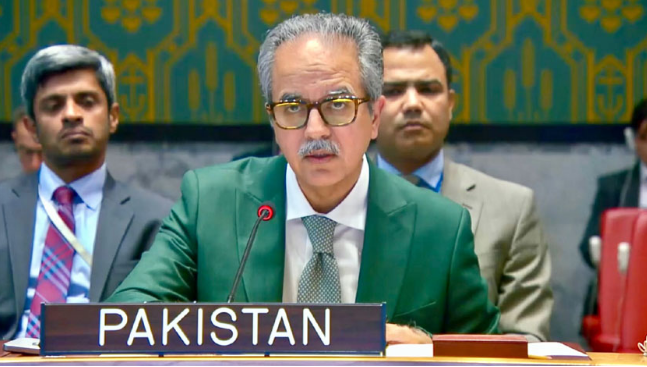
New York (Web Desk): Pakistan has urged the United Nations Security Council (UNSC) to accelerate international assistance for Haiti after a deadly gang assault near the capital, Port-au-Prince, claimed the lives of at least 47 people, including children who had sought safety inside a church.
Addressing an emergency session of the 15-member Security Council on Friday, Pakistan’s Permanent Representative to the UN, Ambassador Asim Iftikhar Ahmad, said the situation in Haiti remained extremely troubling despite ongoing international efforts.
“Regrettably, the situation in Haiti has seen little improvement,” Ambassador Asim Iftikhar Ahmad, permanent representative of Pakistan to the UN, told the Council as members gathered to discuss the latest developments in the violence-hit Caribbean nation.
He said the latest attack once again exposed the severe and prolonged insecurity endured by Haiti’s population, particularly as armed gangs continue to carry out violent assaults against civilians.
“The latest incident is a grim and stark reminder of the long drawn precarious security situation faced by the Haitian people with atrocious attacks by gangs targeting the civilians that disproportionately affect women and children.”
The Security Council had approved a multinational Gang Suppression Force (GSF) for Haiti in September 2025 under Resolution 2793. The force was established to take over from the Kenyan-led security support mission at a time when gang violence was rapidly worsening.
Referring to the multinational force, Ambassador Asim Ahmad said several logistical difficulties were still delaying its full deployment and operational capability.
He stressed that the force must be sent into action promptly and equipped with adequate resources so it could discourage gang attacks and help restore confidence among ordinary Haitians.
“For a secure environment to take hold, the flow of illegal weapons into Haiti must stop,” Ambassador Asim Ahmad stressed.
The Pakistani envoy also maintained that restoring stability in Haiti would require more than international security assistance. He said the underlying political, social and economic factors contributing to the country’s instability would also have to be addressed.
“While international support for Haiti, including from this Council, remains crucial, a durable solution requires addressing the underlying multifarious drivers of instability,” he said.
“This would require a Haitian-led and Haitian-owned response, aligned with its domestic circumstances,” the Pakistani envoy said, expressing hope that political stakeholders in Haiti would put aside divisions and work collectively towards a lasting solution.
The UNSC was also briefed by Carlos Ruiz Massieu, the UN Secretary-General’s Special Representative and head of the United Nations Integrated Office in Haiti (BINUH), who strongly condemned the latest gang assault in Kenscoff, a commune located close to Port-au-Prince.
According to Massieu, the violence occurred during the night of August 23-24, when gang members torched homes and attacked people attempting to escape.
Among those seeking refuge were civilians who took shelter inside a church. He called for everyone abducted during the assault to be freed immediately and without conditions.
Massieu said the attack was the latest in a series of violent incidents that have struck Kenscoff since early 2025. He warned that the assault demonstrated the growing ability of gangs to move their operations outside Port-au-Prince and increasingly challenge the authority of the Haitian state.
The scale of the violence was further reflected in BINUH figures, which recorded 1,408 people killed and another 656 injured across Haiti between April and June 2026 alone.
Massieu welcomed improved coordination between the Haitian National Police, the Haitian Armed Forces and the Gang Suppression Force, while also pressing for the multinational force to be deployed fully and without further delay.
He stressed, however, that security operations would need to be backed by broader efforts aimed at rebuilding state authority and improving daily life for the population.
These measures should include restoring essential services, reopening schools and health facilities, protecting livelihoods and creating opportunities for young people to leave gang networks.
Massieu also called for accountability for those behind the violence, including individuals who carry out, finance, supply weapons to or otherwise facilitate gang activities.
He emphasised that international promises and commitments must now lead to practical and measurable action on the ground.
Neo News | Copyright © 2026