Thu, September 17, 2026

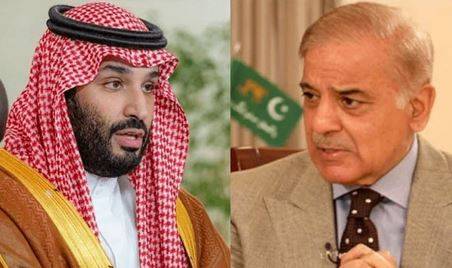
Islamabad (Web Desk): Prime Minister Shehbaz Sharif held a telephone conversation with Saudi Crown Prince Mohammed bin Salman, in which he strongly condemned the recent Israeli airstrikes on Iran and the subsequent attacks on certain Gulf countries.
According to a statement issued by the Prrime Minister's Office (PMO), the premier expressed serious concern over the heightened regional tensions and their potential impact on peace and stability in the Middle East.
He described the recent military actions as highly dangerous and warned that such steps could further aggravate the already fragile situation in the region.
The premier emphasized that these developments threaten the security, stability, and harmony of neighboring countries and the broader Gulf region.
During the discussion, PM Shehbaz reaffirmed Pakistan’s unwavering support and complete solidarity with the Kingdom of Saudi Arabia (KSA).
"Pakistan stands firmly alongside its Saudi brothers in all circumstances, pledging to safeguard the sovereignty, security, and territorial integrity of the Kingdom," the premier reiterated.
PM Shehbaz also highlighted Pakistan’s readiness to play a constructive and positive role during this critical juncture. He stressed that Islamabad seeks peaceful solutions and encourages diplomatic engagement to de-escalate tensions.
PM Shehbaz prayed that the blessings of the holy month of Ramadan bring swift peace, stability, and harmony to the region, allowing countries to focus on cooperation and development rather than conflict.
Earlier on Saturday, Israel and the United States (US), on Saturday launched strikes on Iran, setting off a renewed phase of conflict in the Middle East.
President Donald Trump stated that Washington’s objective was to dismantle Tehran’s missile stockpiles and ensure it could not move forward with developing a nuclear weapon.
Tehran responded rapidly by firing a wide-ranging volley of missiles at targets in Gulf countries and Israel, sharply heightening regional tensions.
The Islamic Revolutionary Guard Corps announced that its strikes were directed at the headquarters of the US Fifth Fleet in Bahrain, additional American facilities across the Gulf region, and selected sites within Israel.
Soon after the missiles were launched, reports emerged of explosions and intensive air defence operations in Saudi Arabia, Bahrain, Qatar and the United Arab Emirates (UAE), as well as in Israel and Iraq.
The large-scale missile attack followed repeated assurances from Iranian officials that any aggression against their territory would be met with a powerful counterstrike.
Multiple Gulf Arab governments confirmed they had come under attack.
Kuwait, Qatar, the UAE and Jordan reported that their air defence systems successfully intercepted incoming Iranian missiles.
In the UAE, state-run media said one person was killed in Abu Dhabi amid the escalation.
Neo News | Copyright © 2026