Thu, September 17, 2026

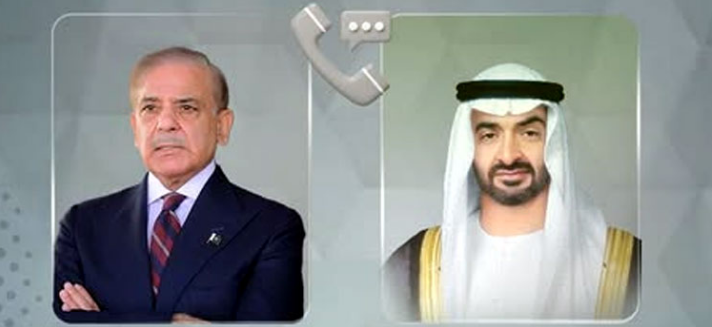
Islamabad (Web Desk): Prime Minister Shehbaz Sharif on Saturday held telephonic conversation with the President of the United Arab Emirates (UAE) and Ruler of Abu Dhabi, Sheikh Mohamed bin Zayed Al Nahyan, to exchange views on the rapidly deteriorating security environment in the region.
During the discussion, the prime minister voiced strong criticism of the heightened instability triggered by Israel’s strike on Iran earlier in the day, which was followed by further attacks targeting the UAE and other Gulf nations.
He characterized the unfolding events as alarming and warned of the broader implications for regional peace.
Reiterating Pakistan’s position, PM Shehbaz conveyed complete solidarity with the Emirati government and its citizens during this challenging period.
He stressed that Pakistan remains steadfast in its support for the UAE, noting that the enduring and brotherly relationship between the two countries has withstood numerous trials over the years.
The prime minister also expressed deep sadness over the loss of a Pakistani national who was killed in a missile strike on Abu Dhabi.
He offered his sincere condolences to the grieving family and shared in their sorrow at the tragic loss.
Israel and the United States (US) launched coordinated military action against Iran on Saturday, intensifying unrest across the Middle East and pushing the region into a dangerous new stage of confrontation.
US President Donald Trump said the strikes were intended to neutralise Tehran’s missile reserves and block any further progress toward acquiring a nuclear weapon. He portrayed the move as a preventative measure aimed at eliminating what Washington views as a serious security threat.
Iran responded swiftly, unleashing a sweeping missile offensive targeting sites in Gulf states as well as Israel, sharply escalating regional tensions. The Islamic Revolutionary Guard Corps announced that its missiles were aimed at the US Navy’s Fifth Fleet headquarters in Bahrain, additional American military facilities across the Gulf, and selected targets inside Israel.
In the immediate aftermath of the launches, blasts were reported and air defence systems were activated across Saudi Arabia, Bahrain, Qatar and the United Arab Emirates, along with areas of Israel and Iraq, highlighting the breadth of the unfolding crisis.
The extensive missile retaliation followed repeated warnings from Iranian authorities that any assault on their soil would provoke a decisive counterattack. Governments across the Gulf later confirmed that their territories had been targeted during the barrage.
Kuwait, Qatar, the UAE and Jordan reported that their defence systems successfully intercepted the incoming projectiles.
In the UAE, state-run media said one individual was killed in Abu Dhabi as the escalation reverberated across the region.
Neo News | Copyright © 2026