Thu, September 17, 2026

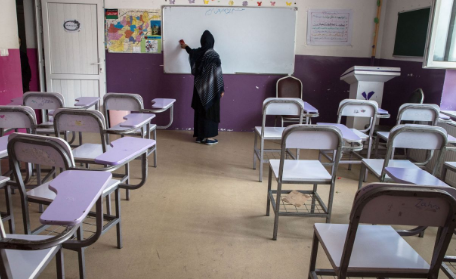
New York (Web Desk): United Nations International Children's Emergency Fund (UNICEF) has warned that restrictions on girls’ education and women’s employment in Afghanistan may result in a shortfall of more than 25,000 female teachers and health workers by the year 2030.
The organisation said the impact is already being felt, with children losing access to schooling and healthcare, while the country’s economy and essential public services are increasingly strained due to the absence of qualified women professionals.
In a newly released assessment titled The Cost of Inaction on Girls’ Education and Women’s Labour Force Participation in Afghanistan, UNICEF noted that women’s presence in the civil service declined from 21 per cent in 2023 to 17.7 per cent in 2025.
Since the Taliban administration barred girls from attending secondary school in September 2021, over one million girls have already been deprived of education.
The report further warns that if the ban remains in place until 2030, more than two million girls will miss out on education beyond the primary level in a country that already has one of the world’s lowest female literacy rates.
UNICEF Executive Director Catherine Russell expressed concern over the long-term consequences, stating, “Afghanistan cannot afford to lose future teachers, nurses, doctors, midwives and social workers, who sustain essential services. This will be the reality if girls continue to be excluded from education.”
She further called on the de facto authorities to remove the restriction on secondary education for girls and urged the global community to continue supporting the right of Afghan girls to learn.
The report highlights a worsening double challenge: the immediate loss of skilled female workers and the long-term inability to replace them with a new educated generation. By 2030, Afghanistan could face a shortage of around 20,000 female teachers and 5,400 women working in healthcare.
The education system is already under pressure. The number of female teachers in primary education has dropped by more than nine per cent, falling from about 73,000 in 2022 to nearly 66,000 in 2024.
UNICEF warned that this decline is likely to harm overall learning outcomes, especially for girls, who are more likely to continue their studies when female teachers are present.
The situation is expected to be even more critical in healthcare, where cultural restrictions often limit women’s access to male medical professionals. The agency said that a decline in female health workers would directly reduce access to maternal, newborn, and child health services, putting women and children at greater risk.
UNICEF also estimated that restrictions on girls’ education and women’s employment are already causing Afghanistan to lose around $84 million annually in economic productivity, with losses expected to rise further if the situation continues.
Despite these challenges, UNICEF said it is still working to support education for children across the country. In 2025, more than 3.7 million students in public schools received emergency educational assistance, while 442,000 children—about 66 per cent of them girls—were enrolled in community-based learning programmes. The organisation has also helped construct or restore 232 schools.
Reiterating the broader consequences, Catherine Russell said, “Denying Afghan girls access to secondary education robs an entire nation of its potential – locking girls, their families and their communities into poverty, weakening health outcomes and silencing the economic engine that an educated generation of women could ignite.”
Neo News | Copyright © 2026