Thu, September 17, 2026

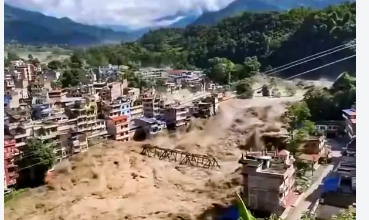
Kathmandu (Web Desk): The number of people killed in the flash flooding that struck the Himalayan region along the Nepal-China border has reached 95, police said.
The devastating flooding swept through parts of Nepal bordering China’s Tibet on Wednesday, destroying villages and damaging sites linked to infrastructure projects. Authorities warned that the disaster could have caused a large number of casualties and advised residents living near riverbanks to move towards elevated and safer areas.
Nepal’s Tourism Ministry reported that 341 foreign nationals were unaccounted for after the floods caused widespread destruction in the affected region.
Government officials said Syapru Besi and Timure, both located in the mountainous Rasuwa district, suffered severe damage. People living near the Bhote Koshi River were urged to stay highly alert because of the continuing risks.
“We have reports of villages and infrastructure project sites being washed away,” district administrator Narendra Pariyar told Reuters. He said authorities did not yet have reliable figures for the number of deaths or the extent of property damage.
“There could be heavy casualties or loss of property,” he said. “But I cannot say for sure now.”
Prime Minister Balendra Shah said emergency response teams had been mobilised, with rescue and relief workers, police and military personnel sent to the affected areas to assist those impacted by the disaster.
“Instructions have been given ... to move the people living in the lower areas to safer places,” he said.
The government also issued a warning to communities situated along the river, asking them to take the threat seriously and remain watchful.
“People along the river are advised to exercise extra caution and remain alert,” the government said in its statement.
The Bhote Koshi River originates on the Tibetan side before entering Nepal, where it eventually joins the Trishuli River. The river then continues into India, where it is known as the Gandak River.
According to a regional climate monitoring organisation, the flash flood occurred after a supraglacial lake in Tibet suddenly drained, sending a large volume of water downstream.
Neo News | Copyright © 2026