Thu, September 17, 2026

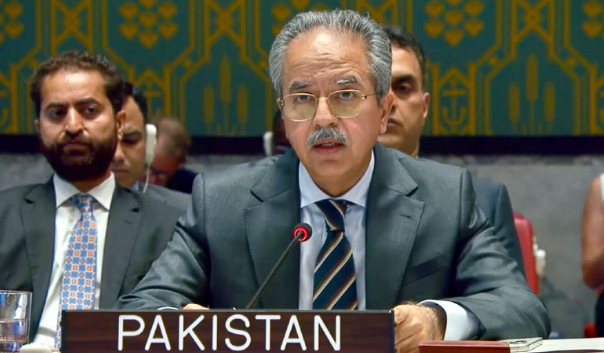
New York (Web Desk): Pakistan has called for sustained international coordination, cooperation and full compliance with international humanitarian law to address the worsening situation in Sudan, stressing that the only viable path towards a durable resolution remains a Sudanese-led and Sudanese-owned political process.
Addressing a United Nations Security Council session on the situation in Sudan, particularly the crises affecting Darfur, Kordofan and Blue Nile, Pakistan’s Permanent Representative to the UN, Ambassador Asim Iftikhar Ahmad, voiced serious concern over developments in El Obeid.
He warned that the Rapid Support Forces’ (RSF) increasingly aggressive military stance and the possibility of further escalation should be assessed in light of the repeated mass atrocities reported across Darfur, including in El Geneina and El Fasher.
Ambassador Asim Iftikhar Ahmad said that achieving a peaceful, stable and united Sudan was essential not only for the country but also for peace and prosperity across Africa.
The Pakistan’s envoy pointed out that the prolonged conflict, large-scale displacement and growing humanitarian emergency were creating serious risks for stability throughout the region.
“Unfortunately, over the years, Sudan has been gripped by recurring conflicts, the most recent episode of which is now entering its fourth year with tragic consequences. Civilians continue to bear the heaviest cost,” he said.
Strongly denouncing attacks targeting civilians and civilian infrastructure, the ambassador called on the Security Council and the wider international community to guarantee that humanitarian assistance could reach everyone in need safely, quickly and without obstruction.
“The Security Council and the international community cannot stand by as another city – more civilians – are subjected to such atrocities,” he said.
Pakistan called on all sides to fully respect their obligations under international humanitarian law, stressing that civilians must be safeguarded and humanitarian personnel should be able to deliver life-saving assistance safely and without interference.
The ambassador also recalled that the commitments agreed upon under the Jeddah Declaration continued to apply and urged the Security Council to press for their complete implementation.
Ambassador Asim Iftikhar Ahmad also called for greater cooperation between the United Nations, humanitarian organisations and the Sudanese government to respond to the country’s humanitarian needs and help close critical funding shortfalls.
While acknowledging the urgent need for humanitarian relief, Pakistan’s envoy stressed that aid by itself could not bring the conflict to an end.
He reiterated Islamabad’s opposition to any steps that might create rival political structures or contribute to the further division of Sudan.
“The Council must preserve the distinction between the national armed forces of a sovereign State and a militia accused of mass atrocities and genocidal violence,” he emphasized.
He underscored the importance of the Sudanese Armed Forces continuing to serve as the country’s main military institution to prevent additional RSF gains.
He also welcomed the African Union Peace and Security Council’s engagement with the Sudanese government, aimed at strengthening coordination and preventing outside actors from interfering in the conflict.
Pakistan further emphasized that the Sudanese people have the right to pursue a peaceful political settlement. It called on the Security Council to reaffirm its support for protecting Sudan’s unity, sovereignty and territorial integrity, along with the country’s national institutions.
Neo News | Copyright © 2026