Thu, September 17, 2026

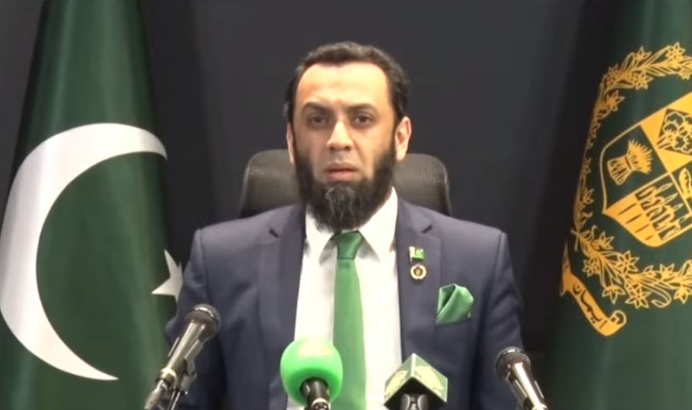
Islamabad (Web Desk): Federal Minister for Information and Broadcasting Attaullah Tarar has stated that a full year has passed since the Pahalgam incident, yet India has not been able to produce any solid or convincing evidence to support its narrative.
Speaking during a special televised address, he described the episode as a reflection of flawed thinking rooted in arrogance, hollow claims, and misplaced pride. He remarked that India has failed to respond satisfactorily to the many questions that have been raised about what happened.
The minister said that India has a pattern of presenting its internal challenges as if they were caused by external forces, while at the same time labeling internationally acknowledged disputes as its own domestic matters.
Tarar said terrorism remains an internal issue for India that it tries to externalize, whereas the Jammu and Kashmir dispute is globally recognized but is portrayed by India as an internal affair.
Tarar further argued that India’s narrative has gradually lost credibility and that the Pahalgam incident fits into what he described as a recurring pattern of alleged false flag operations. He criticized the manner in which the situation was handled, calling it unsophisticated.
He added that when Prime Minister Shehbaz Sharif proposed an independent and transparent investigation, India chose not to engage, which, in his view, raised further doubts and suggested reluctance to face scrutiny.
Highlighting irregularities, Tarar pointed to the unusually swift registration of an FIR within minutes of the incident, noting that such speed was questionable given the distance between the location and the police station.
He also mentioned that various segments, including international media, Indian civil society, political figures, and think tanks, had voiced concerns and raised important questions about the episode.
The information minister said that attempts to build global narratives based on misinformation and staged incidents do not hold up for long, which is why India has struggled to present a convincing case.
He said that neither credible proof nor substantial evidence has been shared publicly to validate India’s claims.
Tarar also criticized Indian media, accusing it of amplifying tensions and promoting unverified and exaggerated reports that created a war-like atmosphere. He said that this approach exposed weaknesses in the narrative rather than strengthening it.
Turning to broader concerns, Tarar spoke about the condition of minorities in India, alleging that they face discrimination under the influence of Hindutva ideology and that Muslims, in particular, are subjected to violence. He further claimed that India uses terrorism as a policy tool and has been linked to such activities beyond its borders.
Referring to incidents involving Sikh leaders abroad, he suggested that these cases point toward state involvement. He also mentioned the case of Kulbhushan Jadhav as evidence that, according to Pakistan, supports its claims about Indian activities.
He asserted that there is clear proof of India’s role in supporting destabilizing actions within Pakistan, including backing groups such as BLA and TTP, and that such evidence has been shared with international stakeholders and media outlets over time.
The information minister cited specific incidents, including the Jaffar Express attack and the Khuzdar episode, as examples where Pakistan believes India played a role. At the same time, he emphasized that Pakistan continues to confront terrorism effectively and remains committed to eliminating it completely.
Tarar said that that the entire nation stands united in its determination to counter terrorism and defend the country’s sovereignty and security.
He said Pakistan will continue taking all necessary steps to address these threats and that the international community has witnessed the country’s efforts and sacrifices in this regard.
Commenting on recent remarks by Indian military leadership about a potential new operation, the minister described them as indicative of frustration and setbacks. He warned that any aggressive move would receive a prompt, strong, and decisive response from Pakistan.
Tarar also referred to what he called Pakistan’s success in “Marka-e-Haq,” claiming it marked a clear victory, while India continues to deal with the consequences of its losses.
“Pakistan’s position has gained recognition internationally, presenting the country as a proponent of peace, while India faces growing isolation,” the minister said.
Tarar credited the leadership of Prime Minister Shehbaz Sharif and Field Marshal Syed Asim Munir for their continued efforts toward peace and stability.
He said that both political and military leadership are aligned in their commitment to national defense and will take every possible measure to protect the country.
The information minister said that Pakistan has emerged as a bright and united nation with strong resolve among the comity of nations and prayed for the country's continued peace, stability and prosperity.
Neo News | Copyright © 2026