Thu, September 17, 2026

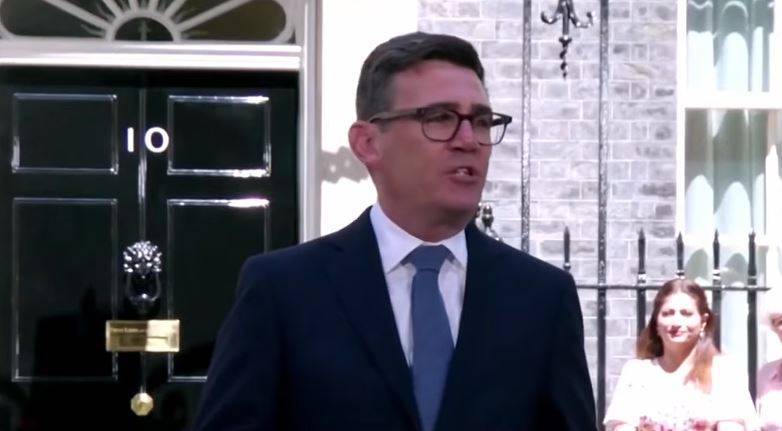
London (Web Desk): London: Andy Burnham officially assumed office as Britain's prime minister on Monday after King Charles III accepted Keir Starmer’s resignation and invited the Labour politician to form a new government, according to Buckingham Palace.
The palace confirmed the appointment in a statement, saying, “Andrew Burnham MP accepted The King’s offer and kissed hands upon his appointment as Prime Minister,” and added that the King had formally requested him to establish the next government.
Addressing the nation for the first time outside 10 Downing Street, Burnham vowed to unveil fresh measures this week to ease pressure on household finances before introducing a long-term 10-year strategy for the country later this year.
“Britain needs to show the world that we can regain our stability once again,” Burnham said. “We have not been good enough, and we need to be better.”
According to reports, a large gathering of supporters cheered loudly and applauded as Burnham stepped outside Downing Street to deliver his first speech as prime minister.
Burnham becomes the sixth person to occupy Downing Street as Britain's prime minister within the past decade, taking charge of a government burdened with multiple pressing challenges and little time to prove his leadership.
He succeeds the unpopular Keir Starmer, who leaves office just two years after leading the Labour Party to a landslide election victory that ended 14 years of Conservative rule.
In an interview with The Times published late on Sunday, Burnham outlined his vision for the country, saying he intended to bring an end to years of political instability.
“What we’ve been doing hasn’t been working. That’s the way I see it,” he said.
“I am going to try and do things in a different way.”
Attention was also focused on the formation of his senior cabinet, with an announcement expected on Monday over who would replace Rachel Reeves as finance minister.
The former mayor of Greater Manchester, popularly known as the “King of the North,” was selected by the Labour Party after Starmer stepped down last month, with many Labour lawmakers believing he offers the party its strongest chance of countering Nigel Farage’s anti-immigration Reform UK party.
Before departing Downing Street, Starmer defended his record during a farewell address, insisting that his administration had improved the country during its two years in office.
“I am confident that Britain is now stronger and fairer than it was two years ago,” Starmer told reporters in his farewell speech outside his central London office.
“I go with good grace, I go with a smile, and I go proud of everything that we have achieved,” he added.
Messages of congratulations from leaders around the world began arriving shortly after Buckingham Palace confirmed Burnham’s appointment.
European Commission President Ursula von der Leyen said she was eager to work with the new British leader to strengthen cooperation between the European Union and the United Kingdom.
“For the security of our shared continent. And the prosperity of people on both sides of the Channel,” she wrote on X.
European Council President Antonio Costa also expressed hope that relations between Brussels and London would continue to improve.
“In the last two years EU-UK relations gained a new, positive momentum,” Costa posted online.
“I look forward to continuing to further deepen our cooperation for the benefit of our citizens and businesses. The United Kingdom and the European Union are stronger together,” he added.
Deputy Labour Party leader Lucy Powell said on Sunday that Burnham’s experience as mayor, away from Westminster, had given him a better understanding of the “bigger, bolder measures” needed to fulfil Labour’s election commitments.
The new prime minister faces several urgent challenges, including slow economic growth, rising government borrowing costs, a growing welfare bill and the continued arrival of irregular migrants in small boats, an issue that has strengthened support for Reform UK.
His administration will also have to navigate unpredictable energy prices caused by the US-Iran war, along with the uncertainty surrounding US President Donald Trump.
Burnham told The Times he would adopt “a different approach to public spending, and to running the economy — more focused on early investment, early intervention, setting people up for success, and much less paying for failure”.
He also promised “early moves to help” with the cost of living, saying that while campaigning he heard the “pressure people feel around their finances”.
Starmer announced in late June that he would step down as both prime minister and Labour Party leader after a series of scandals, policy reversals and political mistakes weakened his leadership.
Burnham, who returned to Parliament only four weeks ago, now has limited room to manoeuvre as he confronts weak economic growth, high public debt and strict fiscal rules that require government spending to remain aligned with tax revenues.
He previously served as a Labour MP from 2001 until 2017 and held ministerial positions under former prime ministers Tony Blair and Gordon Brown.
Since leaving Parliament, Burnham has reshaped his public image, presenting himself as a down-to-earth politician while combining a relaxed style with an active social media presence.
He has only three years to reverse Labour’s fortunes before the next general election, expected in 2029, with opinion polls indicating Reform UK could emerge victorious.
Speaking to supporters on Friday, Burnham described Labour’s change in leadership as the party’s “last chance” to put things right.
Critics argue that Starmer’s government was not adequately prepared to govern after winning power in July 2024.
Burnham, however, has repeatedly insisted that he has a “plan”.
Even so, his swift rise to the Labour leadership has prompted questions about how he intends to deliver on his promises.
His first major policy decision came on Saturday when he scrapped Starmer’s flagship nationwide digital identity programme, which had been projected to cost £1.8 billion over three years.
A spokesperson said the funds and resources originally allocated to the scheme would instead be redirected “to where it’s most needed, such as helping with the cost of living”.
Neo News | Copyright © 2026