Thu, September 17, 2026

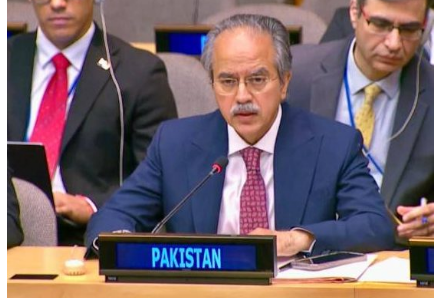
New York (Web Desk): Pakistan has called for a stronger and more meaningful role for women in peacebuilding efforts, stressing that their participation in negotiations must become a standard practice rather than a symbolic gesture.
Addressing a United Nations Security Council (UNSC) debate on Women, Peace and Security (WPS) under the theme “Peace is Decided with Women: Emerging from conflict by enhancing their participation”, Pakistan’s Permanent Representative to the UN, Ambassador Asim Iftikhar Ahmad, said lasting peace cannot be achieved when women are excluded from key decision-making forums.
“Peace built without women is peace built on fragile ground,” the ambassador told the Council, emphasizing that durable peace depends on the insight, leadership and experiences women bring to the process.
He said sustainable solutions can only emerge when women are included not on the sidelines but in the rooms where critical decisions are taken.
More than 70 participants, including senior UN officials, representatives of member states and members of civil society, attended the day-long session.
Speakers noted that despite the adoption of the landmark Resolution 1325 on women, peace and security in 2000, women continue to be largely absent from peace negotiations around the world, even though years of evidence show that their involvement strengthens and prolongs peace agreements.
In his statement, Ambassador Asim highlighted that agreements reached with women’s involvement tend to better address the concerns of local populations and stand the test of time. He noted that women contribute perspectives on social unity, education, healthcare, livelihoods, justice, reconciliation and civilian protection.
“Women’s participation brings attention to social cohesion, education, health, livelihoods, justice, reconciliation and the protection of civilians — issues without which peace cannot take root.”
The Pakistani envoy said women’s involvement in peace efforts should become a built-in feature of mediation and negotiation frameworks. He urged the United Nations and regional organizations to ensure women are represented at senior levels in mediation teams, negotiating groups and peace-support initiatives. “Participation must be safe,” the ambassador stressed.
He further urged the UNSC to support early warning systems, secure avenues for UN engagement and measures that ensure accountability for attacks directed at women.
Asim said that the Council must also tackle the underlying factors that deprive women of peace and security, including protracted conflicts, foreign occupation, poverty, discrimination and impunity.
He added that the Women, Peace and Security agenda should remain closely linked to the principles of the UN Charter, international law and the right of peoples to self-determination.
The Pakistani envoy said that the women join peace processes not merely to increase representation but to ensure that the interests of families, communities and future generations are reflected in discussions that are often dominated by political power struggles.
He pointed out that women in Pakistan have played important roles across diplomacy, peacekeeping, politics, public administration, law enforcement, humanitarian work and civil society.
Asim also praised Pakistani women peacekeepers serving in UN missions, saying their dedication and professionalism demonstrate Pakistan’s commitment to inclusive peace and security.
“If we want peace to last, women must be there from the outset to help shape those decisions,” Ambassador Asim Ahmad emphasized.
Opening the debate, Sima Bahous, Executive Director of UN Women, described gender equality and the empowerment of women as one of the most effective pathways to achieving peace.
She said available evidence consistently shows that when women are included, violence decreases, peacekeeping becomes more effective, accountability improves and peace agreements are more likely to endure.
At the same time, she warned that women continue to be left out of diplomatic efforts despite the growing number of conflicts and crises affecting Afghanistan, Haiti, Myanmar, Lebanon, Palestine, Sudan and Ukraine.
“These are conflicts women neither choose nor lead,” she said, noting that women often suffer the greatest consequences of wars while remaining excluded from the negotiations aimed at ending them.
Bahous urged member states and mediators to put the UN Secretary-General’s Common Pledge on Women’s Participation in Peace Processes into practice.
She called for support for a minimum target of one-third representation for women and regular reporting on the extent of women’s direct involvement in peace negotiations.
Neo News | Copyright © 2026