Thu, September 17, 2026

Islamabad (Web Desk): Pakistan and Afghanistan are engaged in positive and result-oriented discussions to find a peaceful solution to recent border tensions, the Foreign Office announced on Friday
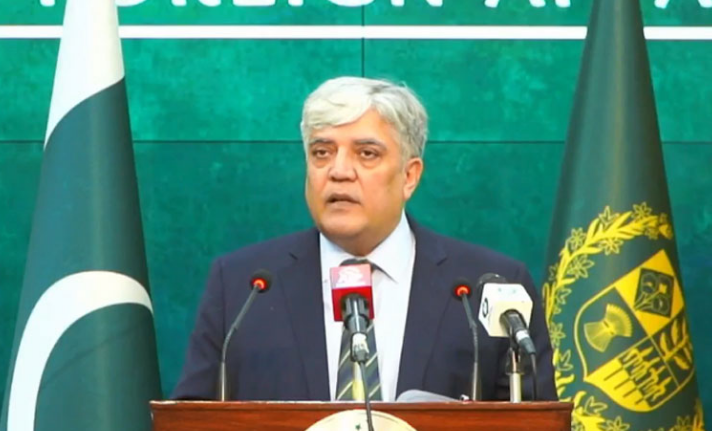
Addressing his weekly press briefing, Foreign Office spokesperson Shafqat Ali Khan said Islamabad had repeatedly alerted Kabul about the presence of Fitna al-Khawarij operating from within Afghan territory. He expressed grave concern over the Taliban’s “provocative” cross-border actions between October 11 and 15, which, he said, Pakistan’s forces had successfully countered in self-defence.
According to Khan, Taliban personnel and militant hideouts under their control faced considerable damage during Pakistan’s retaliatory response. “Our operation was directed against terrorist targets, not civilians,” he clarified, adding that the Taliban later sought a ceasefire, which Pakistan honoured for 48 hours starting from 6 p.m. on October 15.
The spokesperson confirmed that both countries were continuing constructive engagement to reach a peaceful settlement. He said Pakistan expected the Taliban administration to take decisive steps against militant groups and prevent Afghan territory from being used for terrorism, in accordance with its commitments.
Khan reaffirmed that Pakistan respects Afghanistan’s sovereignty and aims to strengthen dialogue and cooperation to tackle terrorism, a challenge shared by both sides. “Recent exchanges between Islamabad and Kabul demonstrate mutual confidence and understanding,” he observed, while appreciating Saudi Arabia’s traditional diplomatic role in promoting stability across the region.
Responding to media queries about reported ceasefire violations, Khan advised journalists to seek detailed information from the ISPR. He clarified that the truce was initiated by the Taliban and negotiated entirely through direct diplomatic channels. “Claims that Pakistan requested the ceasefire are inaccurate,” he asserted.
The spokesperson further said that Pakistan’s approach toward Afghanistan remains unchanged, though its articulation has slightly evolved. He confirmed that both countries’ embassies in Islamabad and Kabul continue to operate normally.
Reiterating Islamabad’s policy of peace and diplomacy, Khan said Pakistan has hosted over four million Afghan refugees for more than forty years and would continue to manage the presence of foreign nationals in line with international practices and domestic regulations.
“Pakistan sincerely desires a peaceful, stable, and prosperous Afghanistan,” he said, expressing hope that Afghans would one day live under an inclusive and representative government.
Khan voiced Pakistan’s strong objections to the recent joint statement issued by India and Afghanistan, calling its references to Jammu and Kashmir a blatant violation of UN resolutions and international law.
He also rejected remarks by Afghanistan’s acting foreign minister that terrorism was an internal Pakistani issue, stating that Pakistan had already shared evidence of active terrorist groups based inside Afghanistan.
“Afghanistan cannot evade responsibility for preventing the use of its territory for terrorism,” he remarked. He accused India of undermining regional peace efforts and reminded that New Delhi itself had a record of sponsoring violence across borders.
“India has no legitimacy to accuse others,” he said, adding that India’s claim of respecting Afghan sovereignty stands in contradiction to its own conduct. He alleged that India continues to provide financial and military assistance to terrorist groups operating in both Pakistan and Afghanistan — actions well known to the international community.
Emphasising the principle of non-interference, Khan said Pakistan firmly rejects any external advice or intervention in its domestic matters.
He affirmed that diplomatic engagement with the Taliban regime remains intact, noting, “Maintaining coordination does not prevent Pakistan from engaging with other stakeholders.”
He added that Pakistan does not interfere in the internal political processes of any country and recognises the right of the Afghan people to determine their political future.
Khan said Pakistan expects the Taliban leadership to uphold the commitments it has made before the international community. He stressed that Pakistan’s recent military actions were defensive measures taken in response to aggression from across the border.
Condemning reports of body desecration and violence in Afghanistan, the spokesperson called such acts “barbaric and inhumane” and urged Afghan authorities to ensure accountability for those responsible.
The FO spokesperson added that Pakistan’s security forces and law enforcement agencies conduct intelligence-based operations in border areas to ensure the safety of citizens.
“Pakistan will continue to protect its people from groups such as Fitna al-Khawarij and the TTP,” he said firmly.
When asked about possible future operations, Khan said speculation was unwarranted but reaffirmed that Pakistan would take all necessary steps to ensure the security of its people.
He confirmed that cross-border trade with Afghanistan had been temporarily halted due to recent firing incidents and heightened tensions.
Concluding his remarks, the FO spokesperson said that the border situation between Pakistan and Afghanistan is a bilateral matter and that Pakistan is fully capable of handling and resolving it.
Neo News | Copyright © 2026