Thu, September 17, 2026

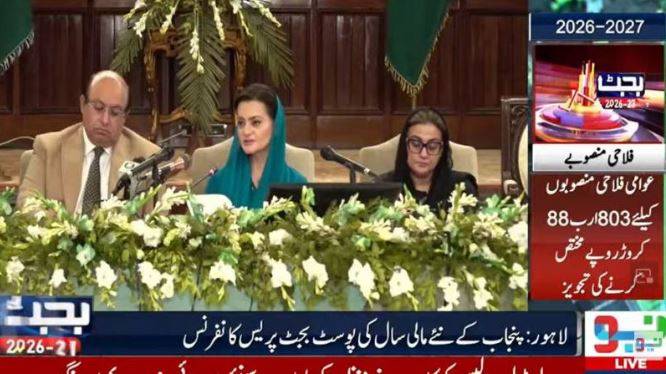
Lahore (Web Desk): Senior Provincial Minister Marriyum Aurangzeb has said that the Punjab government, led by Chief Minister Maryam Nawaz, has presented its third budget, claiming that the province has witnessed unprecedented performance over the past two and a half years.
Addressing a post-budget press conference at 90 Shahrah-e-Quaid-i-Azam, she was accompanied by Finance Minister Mian Mujtaba Shuja-ur-Rehman, Information Minister Azma Bokhari, lawmakers, and senior officials.
She said the 2026–27 budget reflects the government’s vision of public welfare, economic growth, and long-term stability, adding that development work continued despite economic pressures, floods, and limited resources.
The total provincial budget has been set at Rs5,903.46 billion, while Rs752 billion has been allocated under the Annual Development Programme (ADP).
She stressed that no cuts were made in health, education, or social sector allocations. A further Rs783.62 billion has been earmarked for service delivery, marking a 15% increase compared to the previous year.
Marriyum Aurangzeb said provincial revenues have risen significantly from Rs426 billion to Rs820 billion over the last two and a half years, while the Punjab Revenue Authority collected Rs519 billion in the current fiscal year.
She said the government has prioritized industry, agriculture, and livestock sectors. Soft loans worth Rs300 billion at 5% interest will be provided for industrial growth, while Kisan Card Phase II has been allocated Rs10 billion. Under the Kisan Dost programme, farmers have received loans and 31,000 tractors in the past two years.
For fisheries and aquaculture, Rs9.66 billion has been allocated for modern fish markets, while shrimp farming has been launched on 5,500 acres.
She added that Rs38.86 billion has been set aside for slum development, law and order, and basic facilities. The Chief Minister Honhar Scholarship Programme has received Rs22 billion.
In transport, 2,000 electric buses will be introduced at a cost of Rs168 billion, while modern bus depots will be built for Rs164 billion. Over 600 buses are already operating in different cities.
Under the “Apni Chhat, Apna Ghar” housing scheme, more than 1.2 million people have received loans, with a target of 100,000 houses annually. Over 160,000 workers are engaged in the “Suthra Punjab” cleanliness initiative.
In health, Rs169 billion has been allocated for the Nawaz Sharif Medical District Lahore, Rs9.3 billion for cardiac surgery units, and Rs23.37 billion for Children’s Hospital Bahawalpur.
In education, Rs15.69 billion has been set aside for the laptop programme and Rs7.8 billion for new colleges.
She said anti-smog measures are being implemented through a QR code system at brick kilns, while major road networks and tourism projects are also underway. Funds include Rs42 billion for the North Potohar Belt and Rs20 billion for the Religious Trail project.
Finance Minister Mujtaba Shuja-ur-Rehman said no new taxes were imposed in the last two years, and revenue targets have been achieved through reforms and improved compliance. He announced plans to establish a unified revenue authority modelled on the FBR.
Punjab achieved 99% of its tax collection target in the outgoing year, while the 2026–27 revenue target has been increased by 46%.
He said reforms in tax systems, digitisation, and anti-corruption measures have improved revenue collection, with major contributions from PRA, Excise, and Mines and Minerals departments.
He also noted that Punjab provided a Rs546 billion grant to the federation, which reduced the development budget, but stressed that development priorities remain intact.
Marriyum Aurangzeb said the government remains committed to employment generation, environmental protection, and holding local government elections, adding that 250,000 jobs have been created over the past two and a half years.
Neo News | Copyright © 2026